Jun 27, 2011

Long Way 'Round


Greetings from Livingston, Guatemala. I’m out here this week visiting our project with APROSARSTUN, our partner in the region. I don’t think I’ve talked much about this project since being in Guatemala. It’s way out here on Guatemala’s Caribbean coast. This part of Guatemala is really different from the central highlands, where Xela and Totonicapán are located. The area is crazy humid, and the main mode of transportation is boat and canoe. Livingston is a somewhat popular tourist destination, but outside of the tourist center, the rural communities are very remote, very small, and quite underserved. For example, the President of APROSARSTUN is from a village of 15 families. Jose Domingo, EcoLogic’s project técnico is from a community of 35 families, and Samuel, a community promoter recently hired on the project, is from a village of 12 families. Each of these communities are accessible only by boat up small creeks, followed by some walking through the jungle. And each of these communities are part of our project. More than any other EcoLogic project I’ve seen, this one is reaching people way WAY off the beaten path. To me, it’s really cool and really inspiring.

So enough background. This week, I did so many things that each deserve their own post. Thirty-three stoves in Barra Sarstún -- a fishing village on the edge of the Sarstún River-- are being constructed. Francisco, José Domingo, Martín (President of APROSARSTUN,) and I were there to watch/help the first one get built. It was awesome watching the process from the very first brick. I’ve seen so many that are completed and always wondered what it took to build one. As a rule, stove recipients for each EcoLogic project are chosen based on their participation in the project and must help build their stove. In practice, this looks different from project to project. In Barra Sarstún, recipients are members of the Barra Sarstún Fisherfolk Committee, which is the group we work with to develop sustainable fishing practices in the region. The fishermen involved in the committee understand the need to conserve and care for the environment which provides them with their livelihoods (fish!), and are therefore excited to participate in projects which help advance conservation. The stove we watched get built was being installed in a home of a committee member, Don Fabian Vega, who was actually not around to help and got another committee member, Jose Antonio, to cover his labor for him. So Jose Antonio, who is getting his stove in a couple of days, helped our two stove gurus with the construction.

Here’s what you need to build a fuel-efficient stove: cinder blocks, bricks, cement, sand, water, clay/mud (filler in the base of the stove), shovel, machete, trowel, aluminum chimney, and about four hours. And you need to know what you’re doing which is why we hire two men that have built many of our stoves. Oh, I also met some families that really like their stoves and I got to eat some awesome flour tortillas cooked on one. This was the first time I had flour tortillas in Guatemala. They were insanely good. Oh, I also ate a delicious fried fish caught by a member of the fisherfolk committee. Pretty cool. After these 33 stoves are completed, every members of the association will have a fuel-efficient stove in their home.

SO that’s a lot and that’s just the stove. I also visited some agroforestry parcels in some other communities. Come November these parcels will have corn planted in them in rows between the guama trees. The harvest will be in February. I’m coming back down to eat me some guama-protected corn!


While here, EcoLogic also conducted a seminar on conservation and sustainable development project design at  a local school, Ak'Tenamit, which is dedicated to educating students from indigenous families. This school, with which we often collaborate, focuses on ecotourism and rural development, and their hope is that their alumni return to their respective communities to be agents of change. It was great to help facilitate the seminar and hopefully, even if very slightly, help equip these young people with some tools that they can apply in their own communities, to the benefit of their families and neighbors.

Okay, that’s all I got. And it’s starting to rain on me and I’m fairly certain this computer is not waterproof.  Hasta Pronto!

- Chris Patterson, Program Officer for EcoLogic
Chris collaborates closely with the senior program officer by writing grant proposals and project reports, investigating potential funders, and following trends in philanthropy, conservation, and international development. Chris was a fellow for the Ford Foundation's Difficult Dialogues Project and documented his time working from EcoLogic's regional office in Quetzaltenango, Guatemala from March to June, 2011. 

Jun 9, 2011

'Tis the Season

It's now the rainy season here in Guatemala, and if you're a true EcoLogian, you know what the rainy season really means: Reforestation Season!

I'm writing to you from my apartment after a day of reforesting in Totonicapan, Guatemala. I'll tell you one thing: after spending a week with our field technicians in Honduras and hearing all their stories about planting trees and building fuel efficient stoves, it was really rewarding to get my hands dirty and to -- at least for a few hours -- experience the life of a "tecnico." If you remember from a previous post, EcoLogic manages 5 greenhouses (soon to be 8) in Totonicapan in the central highlands of Guatemala, where we work in partnership with the 48 Cantones to reforest watershed areas to help protect drinking water sources. The last time I blogged about this project, I had just visited the greenhouses and they were full of saplings. Well, this time around, hundreds of trees were gone! They're now planted in the forest, where they belong.

Today the EcoLogic team had the opportunity to participate in a reforestation activity in a community.  Typically, the village water committees schedule special events when a town, neighborhood or specific group commit the day to reforestation activities. Local people participate in part because a family's "payment" to the 48 Cantones for receiving water in their home is to volunteer their time to protect the area's watershed and fresh water resources. EcoLogic provides the trees and technical know-how to help make these efforts as productive and successful as possible. Today 120 young people from a local high school  -- the Escuela Noral Rural del Occidente (or ENRO) in Totonicapan -- came out to plant trees and learn about their watershed. Teachers at the school wanted the students to learn about the benefits of the forests in a hands-on manner. Of course, EcoLogic was happy to support this goal: Fernando, our field technician in Totonicapan, led the day's activities, providing a practical "how-to" session for the teachers and students, and showing them how and where to plant the arbolitos..
Fernando, a tecnico, explaing the process to students.

It was an awesome event. After a couple of hours in the forest, the students, teachers, Don Augustin (our greenhouse manager), Fernando, and I were able to plant about 1,500 saplings. There's another youth reforestation event tomorrow, as well, and Fernando is guiding that one, too. Oh yeah, and Fernando saved the GPS coordinates of the first tree that I planted so I can always know its exact latitude and longitude and come back and visit it, which I hope to do annually for the rest of my life! I named it Chris. You're surprised, right?

Okay, that's all I can manage for now. This is actually my last week working from the office in Xela. Next week I'll be visiting our project in Sarstun and after that I'll be in Honduras for our all staff retreat.

Hasta la proxima!


- Chris Patterson, Program Officer for EcoLogic
Chris collaborates closely with the senior program officer by writing grant proposals and project reports, investigating potential funders, and following trends in philanthropy, conservation, and international development. Chris was a fellow for the Ford Foundation's Difficult Dialogues Project and documented his time working from EcoLogic's regional office in Quetzaltenango, Guatemala from March to June, 2011. 

Jun 7, 2011

Me encantan los mapas

Buenas tardes, Compañeros. I just arrived in Guatemala City after a 15.5 hour bus ride from Escuela Agricola Panamericana - otherwise known as Zamorano University -- which is located near Tegucigalpa, Honduras. Despite the many, long bus trips, I had a really great week spending time with almost all of our field staff. The first two days we honed our skills with Geographic Information Systems (GIS) which will help our field technicians and program officers document and monitor our project sites with greater accuracy.  The fact I was able to participate and learn about GIS was fun for me, and will likely improve my ability to collaborate and assist our people in Central America  from our Cambridge office. To gain practice with our GIS skills, we visited the local watershed with Zamorano professors and GIS experts to gather data -- which more or less meant defining its borders -- and then we went back to the lab to input and map the data. Really cool stuff if you´re into maps as I am.

The last two days of the week were spent sharing presentations from everyone´s work. All those present -- 13 in total -- gave at least one power point presentation that summed up her/his work in the field so far this year. Each presentation also allowed for questions and answers afterwards so there was a lot of discussion and sharing of successes and challenges. For me, hearing these presentations was amazingly informative. Our field technicians and program officers are really the hands and feet of EcoLogic - and hearing about agroforestry, stoves, microwatersheds, etc. directly from those implementing our projects was invaluable.

I´m really tired, which you can probably tell because I've scarcely made a joke or a pun! Still I wanted to provide you with an update on this incredible week before it concluded.

Buenas noches!


- Chris Patterson, Program Officer for EcoLogic
Chris collaborates closely with the senior program officer by writing grant proposals and project reports, investigating potential funders, and following trends in philanthropy, conservation, and international development. Chris was a fellow for the Ford Foundation's Difficult Dialogues Project and documented his time working from EcoLogic's regional office in Quetzaltenango, Guatemala from March to June, 2011. 

Jun 3, 2011

Only Four More Weeks?!

Muy buenos días. I haven’t really blogged in a while other than that crazy quetzal post. To be honest, after being able to blog from EcoLogic project sites about things like water sources, agroforestry plots, and community meetings (things which I find really exciting and I’ll assume you do, too), it’s a little hard to blog about being back at a desk in an office. HOWEVER, I’ve got four more weeks down here in Guatemala and three of those four involve plenty of newsworthy happenings. So this is a blog post to get you pumped up for what’s to come!

Next week, I’ll be joining our entire field staff (12 staff members in total, including Country Program Officers and Project Technicians from Guatemala, Panama, Mexico, and Honduras and our Regional Director and Director of Programs) for a 4 day training/meeting in Honduras. For two days our field staff – which luckily includes me for now – will receive training on the use of GIS (Geographic Information Systems) for Watershed Management. Then we’ll have 2 days of team meetings where each Project Technician and Country Program Officer will present updates on their work, which will include successes, lessons learned, technical advice, and future plans. For me, this is EXACTLY the type of information I want to hear. I’m really excited to listen to our field staff’s experiences and stories – they’re the people making the work happen day-to-day. I’ll be sure to keep you informed…

After this trip, I’ll have one week visiting our project in Sarstún, Guatemala. This area is on Guatemala’s Caribbean coast along the border of Belize. This region is quite different from the highlands where I’ve been. Out there I’ll be visiting with beneficiaries of our project with APROSARSTUN – families who have received fuel-efficient woodstoves, farmers who are implementing agroforestry methods, and fisherfolk who are committing to use sustainable fishing practices. Again, really excited, and I’ll be sure to post plenty.

After that, it’s back to Honduras for another week. This time, for EcoLogic’s All-Staff Retreat which we have once every two years. If you’ve ever been to the “Our People” part of EcoLogic’s website, then you’ve seen a picture from the last retreat. Pre-Chris, and pre-several others now working with EcoLogic. Now the reason for the retreat, of course, is not to get an updated picture for the website (although that will happen -- never fear!). It’s so that our entire staff – those based in Cambridge, Guatemala, Mexico, Honduras, Panama, and Belize – can come together to plan, reflect, review best practices, lessons learned and exciting new opportunities to do meaningful work, and also to simply spend time together and get to know one another.  This year we will visit a project site in northern Honduras and then spend a few days in meetings together, with time set aside for activities in the city of Copan Ruinas, an ancient Mayan site in western Honduras.

For many of us at EcoLogic, our relationships with those in other offices are almost exclusively electronic via email or Skype. It's been very exciting for me to finally meet some of my coworkers in person, and I have no doubt that this time we have spent working "shoulder to shoulder" will make us more effective and efficient collaborators in the future. For some at EcoLogic, the retreat will be the first time they have the opportunity to meet many of their colleagues.  For others the retreat will be something like a family reunion. But one thing’s certainly true for everyone: we're all looking forward to it! 

And after I'll return home, just in time for summer in Boston!

PS - There’s already a rumor that an all-staff soccer game is going to happen at the retreat – field staff vs. Cambridge staff. Bet you can guess which team I’m gonna play with! I know you’ll want to see a video, but I’ll just say right now that any footage I capture I’ll be selling to one of those sports bloopers production companies. Hey, relax, as a fundraiser for EcoLogic -- of course!


- Chris Patterson, Program Officer for EcoLogic
Chris collaborates closely with the senior program officer by writing grant proposals and project reports, investigating potential funders, and following trends in philanthropy, conservation, and international development. Chris was a fellow for the Ford Foundation's Difficult Dialogues Project and has documented his time working from EcoLogic's regional office in Quetzaltenango, Guatemala from March to June, 2011. 

May 17, 2011

Quetzal Catch Up

I forgot to mention that rereading this blog made me realize I haven’t updated you recently on my quetzal bird hunt! Don’t worry, not a real hunt. (The only thing I hunt "for real" are fish.) At any rate, you’ve probably been losing sleep from jealousy while imagining me swinging in a hammock with a slew of beautiful quetzal birds perched around me. But, alas, no quetzal fraternizing for me yet. I haven’t seen a one. Every time I think I see one it turns out to be a grackle or something else that's fairly common. I've got six weeks left to go here. Maybe if I wore one of these hats I’d find one? (A care package idea, Mom!)


- Chris Patterson, Program Officer for EcoLogic
Chris collaborates closely with the senior program officer by writing grant proposals and project reports, investigating potential funders, and following trends in philanthropy, conservation, and international development. Chris was a fellow for the Ford Foundation's Difficult Dialogues Project and has documented his time working from EcoLogic's regional office in Quetzaltenango, Guatemala from March to June, 2011.

May 6, 2011

Guama Mia!

Guama Mia! The runaway Broadway hit about a young boy and his pet guama seed. What am I talking about. Okay, honestly, I just wanted to use the word “guama” in a pun. And that’s what I came up with. Mama Mia is a musical, right? Or am I way off?

At any rate, I want to tell you all about guama today. What’s guama, you ask? It’s the variety of tree that EcoLogic uses in the agroforestry parcels that we establish with rural farmers throughout tropical Central America. I had to throw “tropical” in there because it only grows in tropical climates, not up in the mountains. Guama is a pretty amazing tree and perfect for agroforestry in several of the regions where we work. The idea is to plant guama along with your crop, like corn. So you’ll have three rows of corn and a row of guama trees, three rows of corn, and a row of guama, etc. The guama trees provide shade for the corn, their leaves fall (TONS of leaves) and keep weeds from growing, once the leaves decompose they provide organic fertilizer that replenishes soil nutrients, and their lower branches (that grow really fast) can be trimmed and used for firewood. The result is a better crop, a higher yield, healthier soil, fuelwood, and far less time spent maintaining the parcel because weeds hardly can grow at all. Pretty amazing.

Last week I reported to you from Ixcán all about our community consultations. Well, I also was able to spend some time with a farmer, Don Salvador, who has an EcoLogic-supported guama parcel. Don Salvador is a volunteer “forest guard” for his community of San Pablo, and was in touch with EcoLogic several years ago because of the trainings we provided to local forest guards. He expressed interest in trying out guama on a part of his land, and in 2008, EcoLogic established a guama nursery on his land. Though Don Salvador admits that he was a bit skeptical at the beginning, he is now an unabashed believer.
Sebastian, our Regional Director, calls Don Salvador a guama “predicador” or preacher. He grows corn on his guama plot, and talked about how much he loves the guama plot in comparison to the rest of his land where he uses chemical fertilizers. He just did the year’s first corn harvest a few weeks ago, and he talked about the better product from the guama plot, the greater yield, the fact that he didn’t have to purchase fertilizer for the guama plot, and the healthier soil for the next crop.

Don Salvador also mentioned that other farmers are hearing about guama but are still unsure about the process. Without a doubt, though, he’s been convinced. And so have I. I’ve been to maybe 5 or 6 guama parcels now and keep hearing the same things Don Salvador spoke about. There are so many benefits that can positively impact subsistence farmers and the environment.

Okay, well I’m now back in our office for a few weeks after a few weeks of travel. I’ll keep the blog posts coming though. Hasta la próxima!


- Chris Patterson, Program Officer for EcoLogic
Chris collaborates closely with the senior program officer by writing grant proposals and project reports, investigating potential funders, and following trends in philanthropy, conservation, and international development. Chris was a fellow for the Ford Foundation's Difficult Dialogues Project and has documented his time working from EcoLogic's regional office in Quetzaltenango, Guatemala from March to June, 2011. 

Apr 29, 2011

"Good, and how are you?"

Man, it's hot in Playa Grande Ixcan, ya know? If you know a bit of Spanish, the name "Playa Grande" probably gives you images of thatched huts, hammocks, white sand, and margaritas. Well, I'm in the opposite place. Playa Grande Ixcan is here:

Pretty far from the beach. Pretty far from any paved roads for that matter. This is a low-lying, hot, and humid region, and to get here, it's about 3 hours drive on an unpaved road. There wasn't internet in the town for a few days, but it triumphantly returned this morning. So I've been able to check my email and catch up a bit. And write this blog post!

In this region, EcoLogic supports a group called "Mancomunidad de la Frontera Norte," which is an alliance of mayors from neighboring municipalities close to Mexican border who have come together to lead their communities in sustainable development and improve education and healthcare. Ixcan is one of eight municipalities that make up the Mancomunidad de la Froentera Norte, so it's just one particular area where we're working within quite a large region. EcoLogic is helping the Mancomunidad within particular communities located close to forests that are in need of protection and sustainable management. This means, installing fuel-efficient woodstoves, introducing agroforestry techniques to farmers, establishing tree nurseries, and giving trainings to volunteer park rangers referred to as guardabosques, or forest guards.

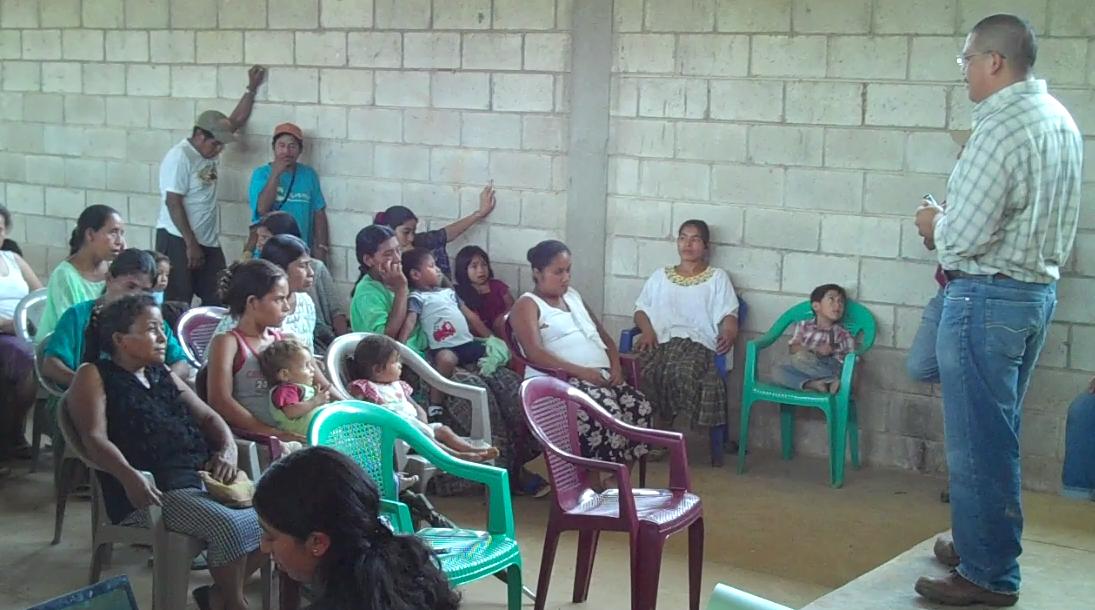
This week, EcoLogic is in Ixcan to facilitate a total of 8 consultations within communities to the southwest of Playa Grande Ixcan. These communities range in size from 120 to 400 families, one of which is a full two hours out of Playa Grande on even bumpier roads. Though we've been working in this area for several years, we're now able to really ramp up our efforts because of a recently formed partnership we've developed with Heifer International.

Before each EcoLogic project begins, we perform what we call a "Community Consultation" which is sort of a diagnostic to try and identify the top priorities of the community - is it water? schooling? a particular illness? a political concern? This way, we're able to all get on the same page from the beginning and tailor our work to the needs and concerns of community members.

Participating in these consultations has been such a great experience. Our Guatemala Program Officer, Francisco Tzul, has been the main facilitator with the support of the tecnico in Ixcan, named Antonio Chipel. There are 9 steps to the consultation, which takes about 3 hours and ends with a lunch. In the first two consultations, we had between 50 and 70 participants in each with representation and participation from men, women, and youth. Getting people to show up to any meeting is hard work, especially when there's tons of work to be done and no such things as vacation or personal time off from work. Just getting people to come together is a testament to the hard work of Antonio Chipel, the Mancomunidad network, and the relationships and reputation we've already established in the area. It also reflects the interest and concern that community members have to improve their communities and their lives.

I have 2 community consultations under my belt and 5 more to go! Pretty exciting to see a project at the beginning stages. It'll be great to follow the project as it develops.

There's plenty more coming your way soon - more news from Ixcan, and an upcoming trip to our project in the Sarstun region on the border of Belize and Guatemala. Which reminds me that I went to Belize, Tikal, and Semuc Champay during Semana Santa last week and didn't even blog about all that!!! Geez. I wish I wasn't so detailed and I could just quickly write about these experiences, but so much happened and there would be so much to report.


- Chris Patterson, Program Officer for EcoLogic
Chris collaborates closely with the senior program officer by writing grant proposals and project reports, investigating potential funders, and following trends in philanthropy, conservation, and international development. Chris was a fellow for the Ford Foundation's Difficult Dialogues Project and documented his time working from EcoLogic's regional office in Quetzaltenango, Guatemala from March to June, 2011.