Showing posts with label community consultations. Show all posts

May 30, 2013

You have the right to remain informed

¡Hola readers!

This past February and March, EcoLogic began its FPIC process in the three land-holding Mayan communities in La Sierra Cojolita Communal Reserve in Chiapas, Mexico. Workshops and information sessions designed to inform the communities about REDD+ were held in the communities of Frontera Corozal, Nueva Palestina, and Lacanhá Chansayab. As the new human rights research intern at EcoLogic, it has been a whirlwind of activity as I learn a ton about the project area, about REDD+, and about the ins-and-outs of working in a non-profit. If you'd like a brush-up on REDD+, David Kramer, Senior Program Officer, has written an excellent post about the mechanism. But wait, you may be saying, what exactly is FPIC and why is it important? Let me take a moment to unpack this term and its importance for both REDD+ and for the EcoLogic project.

Cattle gather in Nueva Palestina, one of the three communities EcoLogic is working with in Chipas. The pressure of ever expanding cattle ranches is one of the principal threats to the Lacándon forest and its natural resources.

FPIC stands for “Free Prior, and Informed Consent,” and is a rights-based approach that puts the emphasis on the rights of local communities to make decisions about the use and management of their land and natural resources. It was codified in the UN Declaration on the Rights of Indigenous Peoples over five years ago. For REDD+, FPIC is especially important because forest-dwelling communities are often disenfranchised and historically marginalized groups. FPIC is an approach that is central to empowering communities to make informed decisions about their futures.

EcoLogic is making the FPIC process in La Sierra Cojolita Communal Reserve a central part to the project planning stage. As I mentioned, there were a series of workshops in February and March that had the goal of giving the communities information about REDD+ and of completing a participatory factor analysis in each community.

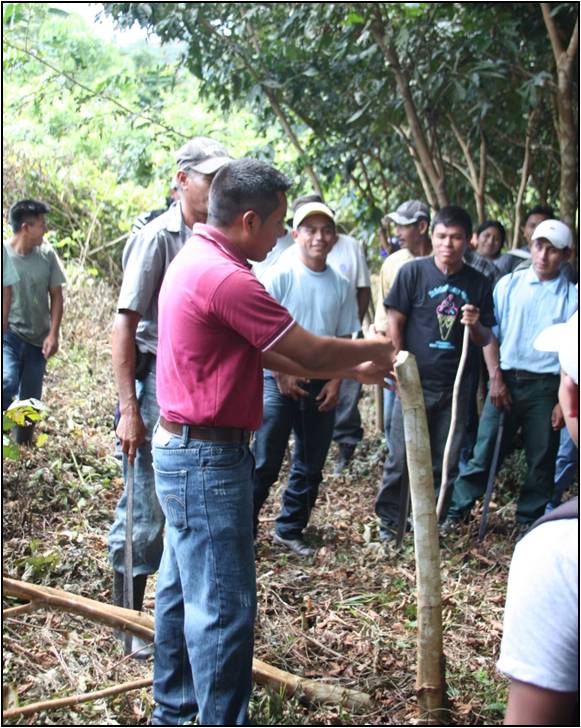
Participants in the workshop prioritize community concerns.

EcoLogic spent three days with each of the three communities, working to address the specific issues and concerns of each, depending on the community context. While this FPIC process has been, and continues to be, a lot of work for EcoLogic, we are committed to ensuring that the communities are empowered to make a truly informed decision about whether or not they want to take part in a REDD+ project. It’s important to stress that the communities will make the decision, and that EcoLogic's role is that of a facilitator and mediator. Our aim is to inform communities about their options.

In the workshops, there was an overarching agenda that was open to change and adaptation depending on the needs of the individual communities. Generally speaking, the first day was devoted to providing introductory information to all community members about EcoLogic, climate change, and REDD+. At the end of the first day, 20 to 30 people were selected by the community to participate in the second part of the workshop, which was the community analysis of factors that impact the possibility of implementing REDD+.

Andrea Savage (center), EcoLogic’s Carbon+ program manager, meets with community members to assess their interest in the project.


Now that the first steps in the FPIC process have been taken, it will be exciting to see how the conversation with the communities continues to evolve and bring to light new information. The experience has been amazing and educational so far, and I'm excited to be learning about a new and still-evolving development tool under the mentorship of EcoLogic, an organization that is doing so much hard work to “do REDD+ right.”

- Anneliese Abney, CarbonPlus Community Engagement Intern
Anneliese works closely with EcoLogic’s CarbonPlus team on project execution and community involvement. She will be graduating from Brandeis University’s Heller School for Social Policy and Management in 2014.

Nov 23, 2012

Green and Lean

Here at EcoLogic we have water projects, we have reforestation projects, we have carbon projects. But guess what? I’m going to go ahead and let you know that I have a favorite. That’s right. Out of all of our programs – agroforestry is my favorite.

Why? Glad you asked. It’s because I’m cheap. Wait, let me explain.

For starters, it’s because our agroforestry program tackles so many issues simultaneously – soil quality, forest cover, food security, and climate change. But the real reason that gets me is – and I’ll have to reveal a little secret – is that it just makes economic sense. And that’s extremely important if you want to get farmers to actually make changes to the status quo. The secret I mentioned is that I’m one of those environmentalists that’s into conservation primarily for economic reasons. Don’t get me wrong, I like animals, beautiful landscapes, and I understand the critical importance of healthy ecosystems in keeping us all healthy, but I really love it when doing something “green” also impacts my bottom line. For example, using less energy means paying a smaller bill. Riding your bike to work means not buying a monthly subway pass. I drive a car than runs on used vegetable oil for Pete’s sake! Yeah, my fuel is “green,” but it’s also free!

The left side of this farmer's plot is using agforestry – the other side is not.

When you add trees to farmland, you activate natural processes which help the corn and other food plants grow better. Adding the right type of trees in the right quantity and in the right places makes soil moister and more nutrient-rich. This ends up producing a more abundant crop. Bigger, healthier crops – just from adding trees! And no need to buy chemical fertilizers and herbicides. EcoLogic works with farmers so that they can test out alley-cropping – one type of agroforestry – on their own land. So many farmers in Central America understand that slash-and-burn agriculture – at least the widespread practice of it – is not only environmentally damaging, but also a poor way to get a decent crop harvest.

Jose Domingo Caal, an EcoLogic técnico, giving a maintenance demonstration of the Inga tree.

Agroforestry answers the timeless question of “what’s in it for me?” EcoLogic doesn't have to go to a farmer and say “Hey, the way you’re farming is bad for the environment, so stop.” No, my friend, we flip it. We say “Hey, we can help you adopt this farming technique that can make your corn bigger and healthier for less money and labor. Oh, and by the way, its way better for the environment, too.”

Yeah, I know that a full-on economic lens toward the environment is a slippery slope, and knowing that, I’m able to keep it in check. The thing is, at the end of the day, I love working for EcoLogic because we show people how conservation doesn't have to be a sacrifice. And it’s not people or the environment. It can be transformative, life-changing, and liberating. Our agroforestry program is a great example of how we do that.


- Chris Patterson, Program Officer for EcoLogic
Chris collaborates closely with the senior program officer writing grant proposals and project reports, and following trends in philanthropy, conservation, and international development.

Jun 20, 2012

Painting the town REDD

It was happening.

After paying my dues for over a year as an intern for EcoLogic, reading stacks of reports and articles about the Lacandón Rainforest and the three Mayan communities that own it, and being just days away from finishing my grad program on sustainable international development, it was actually happening. I was finally getting the opportunity to meet the communities and the forest I had read so much about first hand. This past April, EcoLogic’s very own forest carbon ninja, Bryan Foster (aka CarbonPlus Director), and I traveled to Chiapas, Mexico to collect data for EcoLogic’s Sierra Cojolita REDD+ project.

A landscape view of the Selva Lacandona.

Because you’re all dedicated EcoBlogic readers, I’m sure you remember Dave’s excellent description of REDD+ -- a type of project that reduces the amount of carbon dioxide that’s produced when trees are chopped and/or burned down by working with communities to prevents deforestation. Over the next week, I quickly discover that reading dozens of academic articles and reports does not compare to experiencing the Lacandón Rainforest first hand.
That's me on the left taking notes during our meeting.

We arrived in the city of Tuxtla Gutierrez on a Wednesday, and spent two days meeting with other REDD+ folks, who, like Bryan and I, are crazy enough to dive head first into the complex and at times overwhelming world of carbon.  It was exciting to meet our Chiapas brethren who were a fountain of information about all things REDD+ and Lacandón. But I was itching to get to our final destination, the actual rainforest, which still involved a nine-hour drive along the Guatemalan border.

Enrique Chankin showing off some taro root from his garden.
We met Ricardo Hernández, Lacandón expert and Director of our partner organization -- Na’Bolom, in San Cristobal de las Casas, and began our drive with chilly morning temps and plenty of chatter.  But as the hours went by and the jeep cruised down to lower altitudes, the heat and humidity climbed. We drove through town after town for about 5 or 6 hours until we reached what was supposed to be the edge of the Lacandón Rainforest. Instead, I slowly opened my eyes to scorched trees and oil palm plantations. We were in Marqués de Comillas, a section of the rainforest, which has been settled by farmers who migrated from the center of the country. Oil palm plantations aren’t just bad because rainforests are cleared to plant them and reduce natural biodiversity and critical habitat; the oil palm also contributes to greenhouse gas emissions because of its immense need for petroleum-based pesticides, herbicides and fertilizers.

A couple hours later, we crossed the Lacantún River, and the landscape completely changed. The midday heat had subsided, and we were closer to the Cojolita communities. In this area the forest actually reaches the edge of the road instead of being lost to slash and burn. But this doesn’t mean this section of the rainforest isn’t threatened. Two of the three Mayan communities that own this land are struggling to meet their farming needs with the land they already have, and would like to clear more of the forest.
Enrique Chankin giving us a tour of the rainforest near his eco-lodge, Top Che.
All three communities reside and carry out their farming around the base of the Cojolita mountain range, and the forest on the Cojolita is part of a 35,000 hectare communally owned reserve.  However, the reserve is a source of conflict for the communities. The Lacandones were given authority over the territory by the government over thirty years ago, and they will not grant the Tzetlales and Choles access to the land in the reserve. The Lacandones fear that the other communities will clear too much of the forest in the reserve for farming. The communities show no signs of settling their differences, which, could be detrimental for the rainforest in the Cojolita Reserve. The REDD+ project seeks to help the communities recognize and achieve the economic reward from leaving the rainforest intact as opposed to the current income generating practices such as cattle ranching that require the forest be cut down.
Tzetlal land that was cleared for cattle pasture. Montes Azules Biosphere Reserve in the background.

Driving through Marqués de Comillas provided a frightening peek into what could be the future of the Sierra Cojolita that I would never have seen from my desk in Cambridge. The experience helped me thoroughly understand the critical importance of Na’Bolom and EcoLogic’s role in working with these communities to identify and pursue livelihood alternatives, like REDD+, to help minimize their need to deforest, and allow them to achieve the development goals they are so determined to attain.


A waterfall we came across while touring the area.
We spent the following days meeting with leaders from the Chol and Lacandón communities, two of the three communities that will be managing and financially benefitting from the REDD+ project.  During these meetings we interviewed community members about their land use practices. My prior REDD+ experience took place in Papua New Guinea, possibly the least developed country in the world with the most isolated communities. So I was pleasantly surprised to discover that one of our Mayan interviewees was a social anthropologist and another spoke perfect English.  Unlike their Papua New Guinean counterparts, these rainforest communities are on a well-paved road headed straight for development. This reality check reinforced one of the many lessons I learned in graduate school – there is no such thing as “one size fits all” conservation. Despite the many top-down guidelines that exist for implementing REDD+, EcoLogic and Na’Bolom will have to design a project that is carefully tailored to fit the needs of these unique Mayan communities.

On Monday, as we drove back to the city along Chol territory at the edge of the Cojolita mountain range, Bryan and I saw a plume of smoke drifting over the trees in the reserve – a sign that slash and burn may already be underway. It is clear that Na’Bolom and EcoLogic have an important and challenging road ahead.

-Andrea Savage, CarbonPlus Associate
Andrea works for EcoLogic's CarbonPlus program by writing grant proposals and project reports, and following trends land tenure right throughout Mexico. She recently completed her Master's in sustainable international development at Brandeis University. 

Jun 13, 2012

I'm on my way...

Rio+20+Chris!


Quite the equation. Wait, it needs to equal something. How about: Rio+20+Chris = EcoLogic to the zillionth degree!


Okay, let me break the math down (yeah, I called that math). In 2 days I’ll be representing EcoLogic in Rio de Janeiro at Rio+20, aka the Earth Summit, aka the United Nations Conference on Sustainable Development (another equation: Lots of aka’s = lots of importance). Rio+20 is the most relevant and widely attended gathering of sustainable development practitioners, policy-makers, funders, and thinkers in the world. Why “+20?” Twenty years ago, the UN hosted the first Earth Summit in Rio. Out of that conference emerged the UN Convention on Biological Diversity (which Mexico and all seven Central American countries have ratified) and the UN Framework Convention on Climate Change. At the conference, I’ll have access to hundreds of workshops, presentations, and policy strategy sessions, interacting with representatives from thousands of organizations from all across the world.


That's me looking very pensive. I was visiting a local farmer in Honduras and listening to his presentation on how  he is working with EcoLogic to incorporate agroforestry onto this farm land.


Also coming out of the first Earth Summit in 1992 was a little NGO-that-could called EcoLogic Development Fund. EcoLogic was founded on the principle, promoted by so many rural and indigenous people at the Earth Summit, that truly effective and long-term conservation strategies demanded the inclusion and prioritization of rural voices – their needs, concerns, and ideas. So we’ve got two good reasons for me to be at Rio this year: 1) it’s an important conference for our work, and 2) it is deeply rooted in EcoLogic’s history and legacy.


But there’s an amazing 3rd reason why I’m going, and probably the reason that personally excites me the most. One of EcoLogic’s partners, AJAASSPIB, a local water council in rural Honduras, was named one of 25 winners of the United Nations Development Programme’s Equator Prize. The way I’ve explained the Equator Prize to others is that it’s the Grammys of the community-based sustainable development world. And AJAASSPIB is Radiohead (got to shout out the world’s greatest band whenever possible). Well, that means that AJAASSPIB gets to send a representative, Doña Zumilda Duarte, to Rio to participate in conference activities, multiple trainings, and an award ceremony. Since EcoLogic nominated AJAASSPIB for this award, I’m able to join Zumilda and representatives of the other 24 winners at some of these events. I truly cannot wait to hear what these rural leaders have to say. What they’ve learned and what they still struggle with. What they need and, just as important, what they don’t need.


Doña Zumilda Duarte , community leader and former AJAASSPIB President will be at Rio to accept the Equator Prize. 
So now you see why Rio+20+Chris = EcoLogic to the zillionth degree. It’s an amazing opportunity for us to join AJAASSPIB on this momentous opportunity, engage with peers, promote our work, and learn new insight to bring back to our network of grassroots partners. On top of all that, it offers a unique opportunity for us to reflect, build upon our roots, and reinvigorate our resolve to create a world where both people and nature can thrive.


I’ll keep you posted on how things go. As you can tell, I’m going to be busy. I’ll be tweeting throughout the conference next week so follow us on Twitter @ecologicdevfund and I’ll give you a full wrap up when I return.

Até logo!

- Chris Patterson, Program Officer for EcoLogic
Chris collaborates closely with the senior program officer by writing grant proposals and project reports, and following trends in philanthropy, conservation, and international development. He is also on his way to Rio+20!  

Apr 29, 2011

"Good, and how are you?"

Man, it's hot in Playa Grande Ixcan, ya know? If you know a bit of Spanish, the name "Playa Grande" probably gives you images of thatched huts, hammocks, white sand, and margaritas. Well, I'm in the opposite place. Playa Grande Ixcan is here:

Pretty far from the beach. Pretty far from any paved roads for that matter. This is a low-lying, hot, and humid region, and to get here, it's about 3 hours drive on an unpaved road. There wasn't internet in the town for a few days, but it triumphantly returned this morning. So I've been able to check my email and catch up a bit. And write this blog post!

In this region, EcoLogic supports a group called "Mancomunidad de la Frontera Norte," which is an alliance of mayors from neighboring municipalities close to Mexican border who have come together to lead their communities in sustainable development and improve education and healthcare. Ixcan is one of eight municipalities that make up the Mancomunidad de la Froentera Norte, so it's just one particular area where we're working within quite a large region. EcoLogic is helping the Mancomunidad within particular communities located close to forests that are in need of protection and sustainable management. This means, installing fuel-efficient woodstoves, introducing agroforestry techniques to farmers, establishing tree nurseries, and giving trainings to volunteer park rangers referred to as guardabosques, or forest guards.

This week, EcoLogic is in Ixcan to facilitate a total of 8 consultations within communities to the southwest of Playa Grande Ixcan. These communities range in size from 120 to 400 families, one of which is a full two hours out of Playa Grande on even bumpier roads. Though we've been working in this area for several years, we're now able to really ramp up our efforts because of a recently formed partnership we've developed with Heifer International.

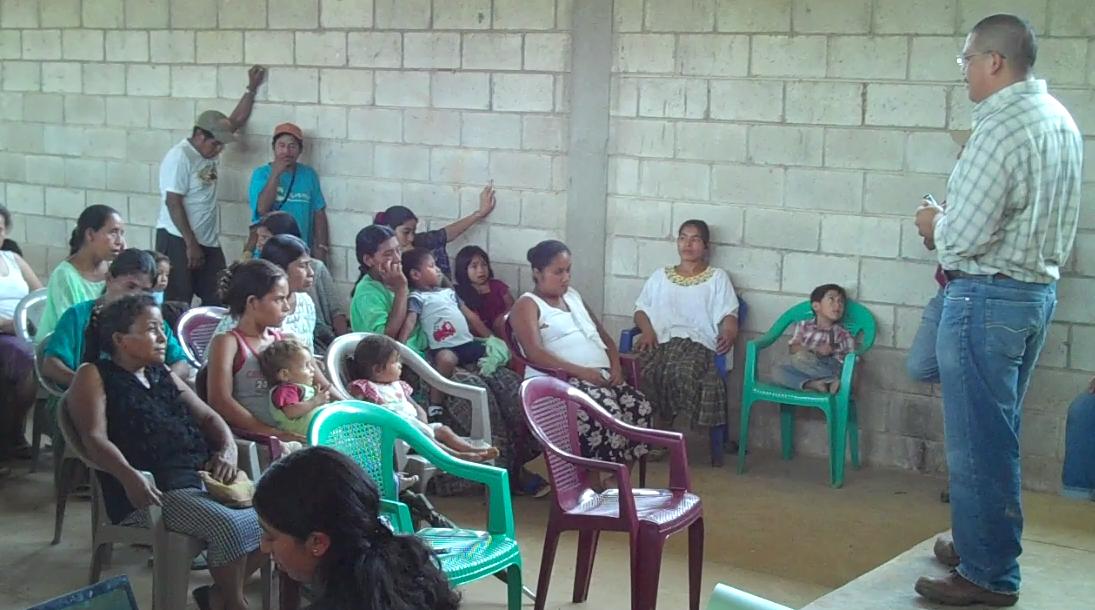
Before each EcoLogic project begins, we perform what we call a "Community Consultation" which is sort of a diagnostic to try and identify the top priorities of the community - is it water? schooling? a particular illness? a political concern? This way, we're able to all get on the same page from the beginning and tailor our work to the needs and concerns of community members.

Participating in these consultations has been such a great experience. Our Guatemala Program Officer, Francisco Tzul, has been the main facilitator with the support of the tecnico in Ixcan, named Antonio Chipel. There are 9 steps to the consultation, which takes about 3 hours and ends with a lunch. In the first two consultations, we had between 50 and 70 participants in each with representation and participation from men, women, and youth. Getting people to show up to any meeting is hard work, especially when there's tons of work to be done and no such things as vacation or personal time off from work. Just getting people to come together is a testament to the hard work of Antonio Chipel, the Mancomunidad network, and the relationships and reputation we've already established in the area. It also reflects the interest and concern that community members have to improve their communities and their lives.

I have 2 community consultations under my belt and 5 more to go! Pretty exciting to see a project at the beginning stages. It'll be great to follow the project as it develops.

There's plenty more coming your way soon - more news from Ixcan, and an upcoming trip to our project in the Sarstun region on the border of Belize and Guatemala. Which reminds me that I went to Belize, Tikal, and Semuc Champay during Semana Santa last week and didn't even blog about all that!!! Geez. I wish I wasn't so detailed and I could just quickly write about these experiences, but so much happened and there would be so much to report.


- Chris Patterson, Program Officer for EcoLogic
Chris collaborates closely with the senior program officer by writing grant proposals and project reports, investigating potential funders, and following trends in philanthropy, conservation, and international development. Chris was a fellow for the Ford Foundation's Difficult Dialogues Project and documented his time working from EcoLogic's regional office in Quetzaltenango, Guatemala from March to June, 2011.