Showing posts with label agroforestry. Show all posts

Jul 30, 2013

Some Gifts Don't Come Wrapped

Last spring, 15-year-old Rebecca Grossman went to Guatemala with her father, Dan. There, they joined Gabriela “Gaby” Gonzalez, EcoLogic’s Regional Program Director, and Daniel Hererra, EcoLogic’s former Program Officer for the country, on a four day tour of EcoLogic’s work at our Indigenous Peoples for Thriving Ecosystems site in northern Guatemala. Dan was kind enough to donate his skills as a multimedia audio and video producer for documenting the trip.. Here are some of Rebecca’s observations from this, her first time visiting a country in Latin America. 

“Why would you want to go to Guatemala?,” a classmate asked as we picked up our things and filed out of the humid classroom and on to our next class. I contemplated the question for a minute, before realizing that I didn’t really have a reason. My dad was the one to decide it would be a good experience for me to join him. I didn’t even know if I really wanted to go.

The next morning, I was awakened by my mom at 4 A.M. for the early flight. Groggy and grumpy, I got my things together and went out to the car. Why did I go along with this? A lump started to form in my throat. I felt overwhelmed and scared. My mom looked at me in the rear-view mirror, as tears starting to fill my eyes. “You’re going to learn so much, and you’ll have lots of fun,” she offered. This was supposed to be my birthday trip—I didn’t want it to be a learning experience! “I want a new birthday present,” I mumbled with tears rolling down my face. “OK, we can get you something when you get back, if that’s what you want,” my mom said calmly. I crossed my arms and sniffled.

This is Yovany Diaz, Gaby Gonzalez, myself, and our tour guide in Lagunas.

The flight was long but when we finally landed we played tourist for a day and went horseback riding. Then we met up with Gaby Gonzalez, the regional director of EcoLogic. Early the next morning we packed our things and piled into a pick-up truck and were on our way. Little did I know that I’d be spending much of the next week in that truck! Gaby made me feel right at home as soon as we started the drive and I started to feel less anxious and more excited about what was coming!

As we got further into the mountains the paved highways turned into rocky roads. I was jolted left and right, up and down, over and over. I knew we were going to visit rural towns, but I could never have imagined how far away and separated from the cities these towns were. We finally arrived at a tree nursery. It had rows of trees of various sizes and varieties in bags. After a short stop at the nursery for some photos and videos, it was time to continue on.
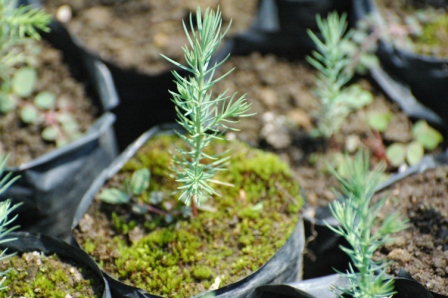
The nursery was filled with these small trees that will be planted to reforest damaged areas of the forest.

Next we stopped at a small restaurant for lunch. The table was lively and full of chatter until a small, scruffy man hobbled in and came over to our table. He stood at one end and begged for food. I had never seen someone beg like this before. In Boston, I’d seen people asking for spare change on the streets. But I’d never seen anyone be so persistent. After a while the woman who owned the restaurant walked over to the man and told him to leave. When he refused, she pushed him forcefully in the direction of the door. After he left, we all quietly returned to eating. The rest of the meal was silent.

My mind went back to what I had said in the car on the way to the airport: “I want a new birthday present.” The more I thought about it, the more embarrassed I felt. While I was worrying about getting a better birthday present, the people here were worrying about whether they were going to find enough food to feed themselves. I couldn’t believe how self-centered I had been; more than anything, I wanted to take those words back.

This mother and her child let us into their home to check out their fuel-efficient stove.

After lunch we were driven to a small community so that my dad could interview a family about a new fuel-efficient wood-burning stove they had been given by EcoLogic. I stood next to my dad’s camera equipment and passed him different lenses and tools as needed. As Dad took pictures and interviewed the family, the children and elders showed interest in my blond hair. They had probably rarely, or never, seen blond hair in person. So it was exiting for them. They all took turns feeling it. As you can imagine, this was very amusing for me.

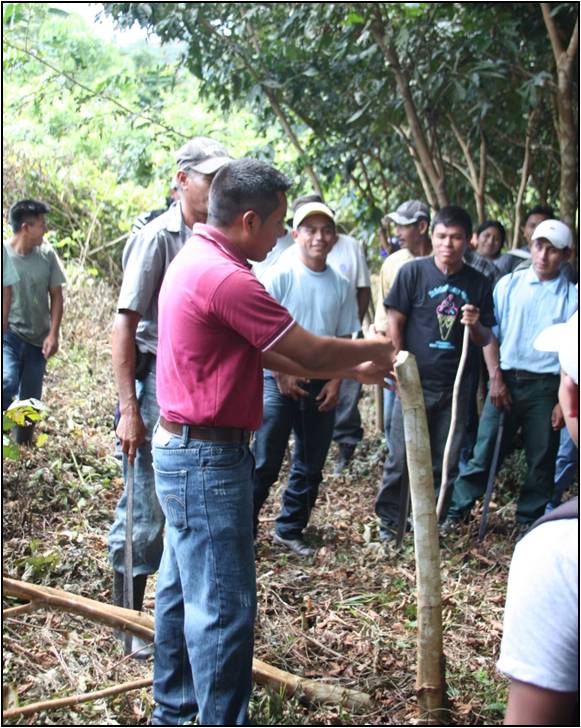
A farmer took a minute to take a picture in the middle of his agroforestry plot.

The rest of the week, we visited other communities, and in particular, observed, recorded, and photographed the destruction of the Guatemalan forests that seems to be happening almost everywhere we went. Farmers often cut down forests for more farmland. It’s called “slash and burn” agriculture in English because the farmers cut down the trees and vegetation that they can with a machete and then light everything on fire. We also got to see some of the areas where EcoLogic was helping to plant new forest patches, and also helping farmers plant a tree called inga, or “guama” in Spanish. This tree rejuvenates the soil through its roots and the leaves that fall, so farmers don’t need to do “slash and burn” anymore.

Here is Gaby poses for a photo with a group of women who volunteer as forest guardians. The forest guardians monitor the forest to prevent illegal logging and help prevent forest fires.

All in all, going on this trip gave me a deeper understanding of culture and poverty. Things are not always black and white and are so much more complex than what I imagined. It was an amazing experience for me to see all those different communities where people use their own indigenous languages, farm for their food, and live so far away from cities I think maybe the next time if my father asks if I want to go on a trip with him to somewhere new, I’ll say, “yes!”

All photos courtesy Dan Grossman

Nov 23, 2012

Green and Lean

Here at EcoLogic we have water projects, we have reforestation projects, we have carbon projects. But guess what? I’m going to go ahead and let you know that I have a favorite. That’s right. Out of all of our programs – agroforestry is my favorite.

Why? Glad you asked. It’s because I’m cheap. Wait, let me explain.

For starters, it’s because our agroforestry program tackles so many issues simultaneously – soil quality, forest cover, food security, and climate change. But the real reason that gets me is – and I’ll have to reveal a little secret – is that it just makes economic sense. And that’s extremely important if you want to get farmers to actually make changes to the status quo. The secret I mentioned is that I’m one of those environmentalists that’s into conservation primarily for economic reasons. Don’t get me wrong, I like animals, beautiful landscapes, and I understand the critical importance of healthy ecosystems in keeping us all healthy, but I really love it when doing something “green” also impacts my bottom line. For example, using less energy means paying a smaller bill. Riding your bike to work means not buying a monthly subway pass. I drive a car than runs on used vegetable oil for Pete’s sake! Yeah, my fuel is “green,” but it’s also free!

The left side of this farmer's plot is using agforestry – the other side is not.

When you add trees to farmland, you activate natural processes which help the corn and other food plants grow better. Adding the right type of trees in the right quantity and in the right places makes soil moister and more nutrient-rich. This ends up producing a more abundant crop. Bigger, healthier crops – just from adding trees! And no need to buy chemical fertilizers and herbicides. EcoLogic works with farmers so that they can test out alley-cropping – one type of agroforestry – on their own land. So many farmers in Central America understand that slash-and-burn agriculture – at least the widespread practice of it – is not only environmentally damaging, but also a poor way to get a decent crop harvest.

Jose Domingo Caal, an EcoLogic técnico, giving a maintenance demonstration of the Inga tree.

Agroforestry answers the timeless question of “what’s in it for me?” EcoLogic doesn't have to go to a farmer and say “Hey, the way you’re farming is bad for the environment, so stop.” No, my friend, we flip it. We say “Hey, we can help you adopt this farming technique that can make your corn bigger and healthier for less money and labor. Oh, and by the way, its way better for the environment, too.”

Yeah, I know that a full-on economic lens toward the environment is a slippery slope, and knowing that, I’m able to keep it in check. The thing is, at the end of the day, I love working for EcoLogic because we show people how conservation doesn't have to be a sacrifice. And it’s not people or the environment. It can be transformative, life-changing, and liberating. Our agroforestry program is a great example of how we do that.


- Chris Patterson, Program Officer for EcoLogic
Chris collaborates closely with the senior program officer writing grant proposals and project reports, and following trends in philanthropy, conservation, and international development.

Sep 6, 2012

Adventures in Agroforestry, Part 2

Since early June 2012, two recent Harvard University graduates, Julian Moll-Rocek and Janie D’Ambrosia, have been visiting EcoLogic’s agroforestry plots in Guatemala to observe, gather data, and provide “tips and tricks” to our EcoLogic field technicians and community farmers on ways to measure and track the progress of their agroforestry efforts. 

Hi again,

It's Janie this time. The last time we wrote Julian and I had just arrived in Ak'Tenamit, a vocational boarding school composed largely of students from the Q'eqchi Mayan communities of the Sarstun region of Guatemala. We received an incredibly warm welcome from APROSARSTUN, an NGO located on the Ak'Tenamit campus and EcoLogic's partner on the ground, and we were finally able to meet the two students with whom we would be working for the next two months. The students, Roland and Matteo, are both in their sixth and final year at Ak'tenamit, and working with us is how they will complete their "practica" -- a two month long field project required to graduate.

This was our private home for a few, magical weeks!

We rented one of the bungalows on campus for the week as we prepared for our 4-6 week trip to the field. Originally, we thought three days would be more than enough to finalize our field methodologies, plan our route, and pick up supplies. As much as we had prepared, our first chat with Rolando and Matteo revealed just how much we still had to learn, including community structure and dynamics, cultural norms and taboos. As biology majors in college, we felt comfortable taking soil samples and measuring tree diameters and soil cover, but evaluating project impact through interviews and community activities was a new experience for us.

During our first one-on-one interview, it became apparent that farmers do not keep reliable track of crop yield, so there was no easy way to quantify the benefits of agroforestry in terms of production. We had to think on our feet and developed a mini-workshop on important numbers for farmers to keep track of during different plot stages. During the coppicing (trimming) of the trees, they can measure how much wood is produced. During harvest, how many ears of corn are harvested. During fruit harvesting , how much fruit is collected. We created a “cheat sheet” to distribute to the farmers with important dates relating to the plot (planting, coppicing, harvest) and the important productivity measures related to each.

This is an agroforestry plot. Those stumps are what the Inga looks like after pruning and the leaves are scattered on the ground to eventually turn into a source of organic fertilizer.  

By far the most important part of our work here has been speaking with agroforestry farmers about why they participated in the project, and finding out what problems they have had related to their plots, and about the help they've received from Ecologic and APROSARSTUN. Their answers are as interesting as they are diverse, ranging in subject matter from community politics to group dynamics to land tenure issues. Overall, the project participants and communities have received us with great warmth and openness. Discussions are often lively and insightful and never so serious that there isn't time for a good laugh and playful banter.

 When we aren't in plots or interviewing project participants or doing community-based work, Julian and I are enjoying the beauty of the small villages, learning how to cook Q'echi-style, and, most importantly, taking an occasional break! After our last meeting in Cerro Blanco, we invited the community to a ukulele jam session (Julian and I both play) as a thank you for their hospitality.

A delicious meal shared with friends.

The evening of ukele strumming was wonderful. A whole mélange of people showed up-- men straight from the field, women and children taking a break from household chores, and young people who wanted to learn chords. By the end of the night, we had young boys singing "Drop, baby, drop" (a Hawaiian favorite)  , and translated "Eight Days A Week" for a sing-along. One of my favorite moments was when a farmer asked, "So what talk do we have to listen to?" We were able to say "No talk, just music and a bit of fun. We hope!" It seemed the least we could do in light of the kindness we'd been shown by the entire community.

 Now we're off to our next community -- Sarstun Creek. The adventure continues!


-Janie

Julian Moll-Rocek has done research in the Amazonian rainforests of Madre de Dios, Peru and Janie D’Ambrosia has previously worked on a national reserve in Southwest Kenya. Both Julian and Janie have degrees in organismic and evolutionary biology, a field that looks at the function, evolution and interaction of organisms—or in this instance, how crops and trees can work together and integrate beneficially into the broader natural ecosystem. They are also showing our field staff techniques to use new technology (such as GPS) to create more accurate maps and georeference the agroforestry plots of the farmers we work with.

Aug 23, 2012

Adventures in Agroforestry

Since early June 2012, two recent Harvard University graduates, Julian Moll-Rocek and Janie D’Ambrosia, have been visiting EcoLogic’s agroforestry plots in Guatemala to observe, gather data, and provide “tips and tricks” to our EcoLogic field technicians and community farmers on ways to measure and track the progress of their agroforestry efforts. 

Hi all!

Janie and I arrived in Guatemala City on June 13th and headed to EcoLogic’s regional headquarters in Quetzaltenango (affectionately known as Xela, by its Mayan name). While crashing on the floor of an extra room in the EcoLogic office, we spent about a week and a half re-familiarizing ourselves with the work EcoLogic is doing in agroforestry—which involves planting trees with corn, I’ll get to the details further down the page.

Home Sweet Home - at least for a few days.

We became interested in EcoLogic when we wrote a case study on the organization for a class on climate change and the global food system. We worked closely with Senior Program Officer David Kramer and to gained an understanding and appreciation of EcoLogic’s mission, goals, and projects. We are particularly interested in helping establish an effective monitoring and evaluation (M/E) system for EcoLogic’s agroforestry project. In essence, we’ll be keeping track of progress, measuring success (or failure), and trying to get a sense of what should be changed. So now we’re here in Guatemala for three months speaking to people in the fields—quite literally—and coming up with a set of recommendations for project modifications.

That's Don Augustín to the left, the greenhouse manager in Totonicapán with técnico Fernando Recancoj and Janie showing off some saplings in a newly constructed greenhouse.

The agroforestry system that EcoLogic promotes is based on the research of the Inga Foundation, which employs a nitrogen fixing tree, Inga edulis, planted in alleys between rows of corn (known as alley-cropping). This technique provides farmers with several advantages: shade from the trees reduces the amount of herbicides they need to kill weeds, the dead leaves from the trees decompose to provide a rich layer of nutrient-rich humus or compost, and finally before the corn is planted, the trees have their branches cut which is often used for firewood, reducing the need to take fuel wood from neighboring forests.

A farmer standing proudly by her agroforestry plot in Guatemala.

After our stay in Xela we headed up to Ixcán, about an hour south of the Mexican border, to see this agroforestry system firsthand. After 9 hours crammed into a minivan, we finally arrived in the town of Playa Grande, where we were welcomed by EcoLogic’s técnico, Antonio Chipel. Nursing our bruised knees and aching backs, we plunged right into work the next day. Bumping around in the back of a pick-up truck, we drove out to a community called Santa Maria Dolores. There, we spoke to farmers who have started working with Inga, visited plots of different ages, and tried out some of the measurements we had come up with to get a better idea of how things were going in the plots. Everyone we met was incredibly warm and open. Even though everyday left us drenched in sweat and dead tired. 


Now, we've arrived in Livingston, Izabal where we will try to use what we learned from Antonio and the farmers in Santa Maria Dolores, Ixcán, to come up with a straight forward set of measurements and questions to keep track of how agroforestry systems are working here.

The food here is unbelievable!

I have to make a brief mention of the food here: it is absolutely UNREAL—fresh corn tortillas mixed with beans and cream and perfectly cooked scrambled eggs for breakfast; a hearty vegetable stew for lunch with corn tamales; maybe a cheese and chicharron filled pupusa for dinner. Everything prepared fresh as you watch!

- Julian

Julian Moll-Rocek has done research in the Amazonian rainforests of Madre de Dios, Peru and Janie D’Ambrosia has previously worked on a national reserve in Southwest Kenya. Both Julian and Janie have degrees in organismic and evolutionary biology, a field that looks at the function, evolution and interaction of organisms—or in this instance, how crops and trees can work together and integrate beneficially into the broader natural ecosystem. They are also showing our field staff techniques to use new technology (such as GPS) to create more accurate maps and georeference the agroforestry plots of the farmers we work with.

May 18, 2012

Illustrating History

The children from 48 Cantones arrive early at the Riecken Library in Xolsacmalja. Running, sweating, pushing and shoving, they ask for the ball to get a few minutes of play in before the creativity workshop starts, three times per week.

They are punctual and responsible. And rarely ever absent. In those cases when a child doesn’t show up, someone from his or her household diligently brings me a handwritten note from the family explaining the child’s absence: “He had to plant in the cornfield today.”

The purpose of the workshop series is to publish a book that collects the stories from the oral tradition in the community, illustrated by children. The stories told are about the Maya Ki’che’ people, the Ajaw of the mountain and the water, and some old rules to save the forest, such as “Pixab”, “Pixan”, “Toj” and “Repuj”. All of these are concepts that direct us as human beings to relate to nature: the mountains, the forest, the water, and the animals.

To collect these stories, we go to the “Plxab” (Council of Elders). Every Thursday we walk down the narrow dirt paths to the house of somebody’s grandfather. The children sit and listen. Usually, they are speaking Ki’che’. So I sit with my notebook, the page blank, until Evelyn comes and translates the story into Spanish for me.

For the illustrations, we are experimenting with different techniques and visual mediums such as painting, drawing, collage, photography and photo montages. We will also go to the forest to listen to the sound of the pines, smell them, touch them, and of course, draw them.


Mr. Urbano, the teacher at the library, also taught us the kirigami technique, cutting paper to make airy and light forms, something that the children enjoy very much. We plan to paint a mural inspired by these simple forms for Reforestation Day in May.

The idea is that we can experience and appreciate the forest, and that all of its stories – which will be represented in the illustrations, can be heard in due time, enjoying the journey and along the way discovering some new perceptions that come from old stories. Because ancestral wisdom is passed down from generation to generation, and we don’t want it to stop with us.

- Special Guest Blogger and ArtCorps Fellow Isabel Carrió. Youth Leaders in Conservation listen, feel, express their thoughts through images and share the ancestral wisdom of their Mayan community, under the guidance of Isabel as part of EcoLogic's ongoing work in Totonicapán, Guatemala. The blog is reproduced from its original posting on artcorp.org.

Apr 18, 2012

Don’t call it a comeback…

Spring has sprung, flowers are blooming, and EcoLogic is blogging. This feels right.

Even though EcoBlogic has been on hiatus since July – EcoLogic certainly hasn’t.With ongoing projects from Mexico to Panama and regional staff working with hundreds of communities with reforestation projects and water source protection, we have plenty to show you.

For instance, did you all know what an inga seed looks like?

Inga, or guama in Spanish, is a plant used in agroforestry. Agroforesty is a method of farming that mixes small trees and shrubs in among crops. Why would you want to do that, you ask? Well, good question. Agroforestry farming takes advantage of the natural benefits of trees and shrubs, such as reducing soil erosion because of their root system, shading crops with their leaves, and then, when the leaves fall and decompose, acting as a natural fertilizer for the soil.

Now, the beauty of using inga is that its native to the areas where we work and when farmers use it in their fields they can, overtime, double their crop yield!

How about fuel-efficient stoves? Have you seen them in action?

This is a stove we built in Honduras and - since we use local, readily available materials - it is made from adobe. For rural communities in Honduras, families typically use open-pit fires, like you would for camping. This method is inefficient and dangerous. The fuel-efficient stoves we build are up to 60% more efficient, so that means less wood has to be collected and fewer trees are removed from the forest.

So that’s why we have created EcoBlogic – to give you a closer look at our work and perhaps see it in a different light. Also, we also want to hear from you - your questions, your comments. Tell us what you think, what you want to know more about, who you want to hear from. We welcome all comments!

Jul 15, 2011

Eco-Family in the Field

The entire Eco-Family spent a week together in sunny --, no wait rainy -- no wait- sunny again Honduras at the end of June for EcoLogic’s biennial retreat. We bonded, we learned, and we exchanged ideas. But this was no kumbaya-fest. Our daily meetings consisted of intense sessions on strategic planning, science-based impact assessments, and theories of change. It was intense, it was real, and it was done EcoLogic-style. There is really too much to tell, so I’ll just highlight my favorite moments.

After arriving absurdly late to a quiet hotel in San Pedro Sula, I was ready for bed. Three hours later I find myself in a minibus driving to our projects in the region of Atlántida to see our work in agroforestry, fuel-efficient stoves, watershed management, and tree nurseries. Let me tell you about two of the project sites we visited, which we are implementing with our local partner, the Alliance of Municipalities of Central Atlántida, otherwise known as MAMUCA.

Fuel efficient stoves; hey what can I say? I love these things. We saw several stoves and heard from three different women who own and use them. I was extremely impressed with the maintenance of all the stoves we saw. I asked at one point, “Are these new?” I thought at MOST they might be a few weeks old but nay, I was told that all of the stoves we saw were a year or older. The women have to sand the stoves down every couple of days to keep them in tip top shape. And boy do they shine – I never knew adobe could sparkle. The women form groups of eight and together THEY make a stove for each person in the group. They are trained on how to construct, care for, and use them. The stoves use less fuel-wood, are more sanitary and keep the smoke out of the home. We all know the benefits of a smokeless house but it was NEVER as apparent as when I walked into one of the homes, stove to the right and a teeny tiny infant asleep in an itty bitty hammock not even 3 feet away. The babe was swinging lightly in the breeze and thankfully its little lungs were breathing clean air. It made me feel really good to see the positive difference we are making.

The argoforestry parcel we visited was also pretty impressive. With 40,000 seeds in the ground, the year-old trees (cue music) stood majestically along the hill-side. The trees are there to improve crop yield (here it’s corn), prevent erosion, and decrease the work of the farmers all while attracting wildlife, preventing disease and diminishing the need to encroach upon the surrounding forest. Don Faustino, owner of the land, was enthusiastic about the results and the benefits of guama. The full benefits will not be seen for another 2 years -- but, so far, so good and Don Faustino is happy to tell others about his success so they can replicate this work.

Oh, and we had an all-staff soccer game. There is not a lot to say about this except it was DEADLY (in a good way). It was fun, it was a time for bonding, and the temperature was freaking HOT. My team made it to the finals (yaay) but alas, the elusive EcoLogic world cup escaped my team’s grasp.

Let me just end this with an enormous shout out to EcoLogic field staff and tecnicos who work on a day to day basis directly with the people and places we strive to support on the ground. In getting to know the regional staff better I was awed by their passion and dedication. Their expertise is astounding and I’m so proud to be working with them.


- Gina Rindfleisch, Program Officer for EcoLogic
Gina manages EcoLogic's fundraising activities targeting individual donations. Prior to joining EcoLogic she served for two years as a Peace Corps volunteer in Nicaragua working in environmental education and holds a BA in environmental studies from Long Island University.