Jul 30, 2013

Some Gifts Don't Come Wrapped

Last spring, 15-year-old Rebecca Grossman went to Guatemala with her father, Dan. There, they joined Gabriela “Gaby” Gonzalez, EcoLogic’s Regional Program Director, and Daniel Hererra, EcoLogic’s former Program Officer for the country, on a four day tour of EcoLogic’s work at our Indigenous Peoples for Thriving Ecosystems site in northern Guatemala. Dan was kind enough to donate his skills as a multimedia audio and video producer for documenting the trip.. Here are some of Rebecca’s observations from this, her first time visiting a country in Latin America. 

“Why would you want to go to Guatemala?,” a classmate asked as we picked up our things and filed out of the humid classroom and on to our next class. I contemplated the question for a minute, before realizing that I didn’t really have a reason. My dad was the one to decide it would be a good experience for me to join him. I didn’t even know if I really wanted to go.

The next morning, I was awakened by my mom at 4 A.M. for the early flight. Groggy and grumpy, I got my things together and went out to the car. Why did I go along with this? A lump started to form in my throat. I felt overwhelmed and scared. My mom looked at me in the rear-view mirror, as tears starting to fill my eyes. “You’re going to learn so much, and you’ll have lots of fun,” she offered. This was supposed to be my birthday trip—I didn’t want it to be a learning experience! “I want a new birthday present,” I mumbled with tears rolling down my face. “OK, we can get you something when you get back, if that’s what you want,” my mom said calmly. I crossed my arms and sniffled.

This is Yovany Diaz, Gaby Gonzalez, myself, and our tour guide in Lagunas.

The flight was long but when we finally landed we played tourist for a day and went horseback riding. Then we met up with Gaby Gonzalez, the regional director of EcoLogic. Early the next morning we packed our things and piled into a pick-up truck and were on our way. Little did I know that I’d be spending much of the next week in that truck! Gaby made me feel right at home as soon as we started the drive and I started to feel less anxious and more excited about what was coming!

As we got further into the mountains the paved highways turned into rocky roads. I was jolted left and right, up and down, over and over. I knew we were going to visit rural towns, but I could never have imagined how far away and separated from the cities these towns were. We finally arrived at a tree nursery. It had rows of trees of various sizes and varieties in bags. After a short stop at the nursery for some photos and videos, it was time to continue on.
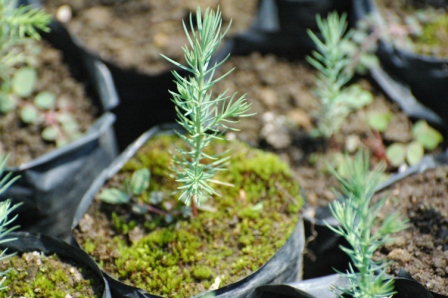
The nursery was filled with these small trees that will be planted to reforest damaged areas of the forest.

Next we stopped at a small restaurant for lunch. The table was lively and full of chatter until a small, scruffy man hobbled in and came over to our table. He stood at one end and begged for food. I had never seen someone beg like this before. In Boston, I’d seen people asking for spare change on the streets. But I’d never seen anyone be so persistent. After a while the woman who owned the restaurant walked over to the man and told him to leave. When he refused, she pushed him forcefully in the direction of the door. After he left, we all quietly returned to eating. The rest of the meal was silent.

My mind went back to what I had said in the car on the way to the airport: “I want a new birthday present.” The more I thought about it, the more embarrassed I felt. While I was worrying about getting a better birthday present, the people here were worrying about whether they were going to find enough food to feed themselves. I couldn’t believe how self-centered I had been; more than anything, I wanted to take those words back.

This mother and her child let us into their home to check out their fuel-efficient stove.

After lunch we were driven to a small community so that my dad could interview a family about a new fuel-efficient wood-burning stove they had been given by EcoLogic. I stood next to my dad’s camera equipment and passed him different lenses and tools as needed. As Dad took pictures and interviewed the family, the children and elders showed interest in my blond hair. They had probably rarely, or never, seen blond hair in person. So it was exiting for them. They all took turns feeling it. As you can imagine, this was very amusing for me.

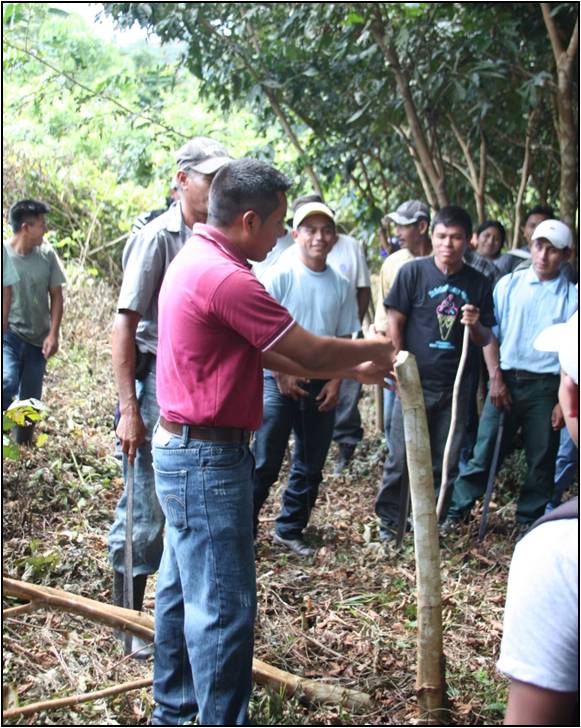
A farmer took a minute to take a picture in the middle of his agroforestry plot.

The rest of the week, we visited other communities, and in particular, observed, recorded, and photographed the destruction of the Guatemalan forests that seems to be happening almost everywhere we went. Farmers often cut down forests for more farmland. It’s called “slash and burn” agriculture in English because the farmers cut down the trees and vegetation that they can with a machete and then light everything on fire. We also got to see some of the areas where EcoLogic was helping to plant new forest patches, and also helping farmers plant a tree called inga, or “guama” in Spanish. This tree rejuvenates the soil through its roots and the leaves that fall, so farmers don’t need to do “slash and burn” anymore.

Here is Gaby poses for a photo with a group of women who volunteer as forest guardians. The forest guardians monitor the forest to prevent illegal logging and help prevent forest fires.

All in all, going on this trip gave me a deeper understanding of culture and poverty. Things are not always black and white and are so much more complex than what I imagined. It was an amazing experience for me to see all those different communities where people use their own indigenous languages, farm for their food, and live so far away from cities I think maybe the next time if my father asks if I want to go on a trip with him to somewhere new, I’ll say, “yes!”

All photos courtesy Dan Grossman

Jun 20, 2013

Welcome to the neighborhood!

Meet Alvin Loredo, fisherman, contractor, tour guide, and common laborer – a jack of many trades. Earlier this year, Alvin worked with EcoLogic to help install fuel-efficient stoves in two communities in the buffer zone of the Sarstoon-Temash National Park in Belize as part of EcoLogic’s binational work between Guatemala and Belize. I recently had the pleasure of speaking to Alvin on the phone to hear first hand how the work went, and why he is so committed to his community.

Alvin giving the lay of the land after a boat ride up the Sarstoon River.

Alvin explains that he first heard of EcoLogic about 10 years ago when he served as a board member to EcoLogic’s partner in Belize, the Sarstoon Temash Institute for Indigenous Management (SATIIM). He accompanied EcoLogic on a learning exchange to Honduras to see projects we were implementing, including the installation of fuel-efficient stoves, and learn directly from community participants in the area. Alvin said when he first walked into the home of family with an EcoLogic stove he was blown away by how clean the inside of the kitchen was, which he described as “white”. In a region where, dirt floors and open-pit fires are the norm he could not believe his eyes.

“I was like, wow, where do you people cook? The pots were shining and I wondered where the smoke was and then I said to myself: the people of Barranco need something like that, too. Since that trip to Honduras, it has always been my dream to get the stoves to Barranco and Belize so that people can see that there are techniques to help us live a little longer.”

So, almost 10 years later when EcoLogic called for his help, Alvin jumped at the chance.

Alvin presenting at a press conference to denounce oil exploration in the Sarstoon Temash National Park.

Alvin was raised and lives in a fishing village on the coast of Belize called Barranco. The population here is roughly 160 inhabitants and it is the coastal gateway to the Sarstoon Temash National Park which is threatened by oil exploration and drilling. Full-time employment is hard to come by in this remote coastal village, but Alvin gets by. He supports his family of three daughters and one boy, through daily labor and fishing the coastal waters. “I know them [the communities] from my heart and would be willing to assist them however I can,” said Alvin.

Installing the fuel-efficient stoves took Alvin about one month. First, he would visit each family in the evening to make plans for the following day’s labor building stoves.

“At around 6 in the morning I would wake, share a cup of good, strong coffee with the stove technician and then go to the first home.” They would then assess the levelness of the area where the stove was to be installed. The “family helper” would begin mixing the sand and cement for laying the blocks and wait for it to set. At that point they would go to the next house to set the foundation. At about midday Alvin would return to the first house to fill the area with mud and red clay, soak the bricks, stomp it down, and make another mix of clay to fill the hole. After that the team would place the outer bricks and plaster the outside to make the stove smooth. This stove design uses about 90 bricks and takes a full day’s work.

“The women could hardly wait to use it, but we told them they must wait 40 days for the bricks to cure. If they use the stove before that, the bricks will crack.”

Here is a recently installed stove in Belize, much like the ones Alvin was helping construct.

Alvin expressed his heartfelt thanks for the work EcoLogic has started in the area he also said it is his hope that it will continue. “There are many more stoves that these communities need. We need to spread the love to as many families as we can.”

Alvin’s island-style charisma, loyalty, and love for his land have made him a leader in his community. He fishes where his grandfather fished, he farms where his grandfather farmed and he does his best to protect the natural resources that the people of Barranco and the next generation depend on.

- Gina Rindfleisch, Program Officer for EcoLogic
Gina manages EcoLogic's fundraising activities targeting individual donations. Prior to joining EcoLogic she served for two years as a Peace Corps volunteer in Nicaragua working in environmental education and holds a BA in environmental studies from Long Island University. 

May 30, 2013

You have the right to remain informed

¡Hola readers!

This past February and March, EcoLogic began its FPIC process in the three land-holding Mayan communities in La Sierra Cojolita Communal Reserve in Chiapas, Mexico. Workshops and information sessions designed to inform the communities about REDD+ were held in the communities of Frontera Corozal, Nueva Palestina, and Lacanhá Chansayab. As the new human rights research intern at EcoLogic, it has been a whirlwind of activity as I learn a ton about the project area, about REDD+, and about the ins-and-outs of working in a non-profit. If you'd like a brush-up on REDD+, David Kramer, Senior Program Officer, has written an excellent post about the mechanism. But wait, you may be saying, what exactly is FPIC and why is it important? Let me take a moment to unpack this term and its importance for both REDD+ and for the EcoLogic project.

Cattle gather in Nueva Palestina, one of the three communities EcoLogic is working with in Chipas. The pressure of ever expanding cattle ranches is one of the principal threats to the Lacándon forest and its natural resources.

FPIC stands for “Free Prior, and Informed Consent,” and is a rights-based approach that puts the emphasis on the rights of local communities to make decisions about the use and management of their land and natural resources. It was codified in the UN Declaration on the Rights of Indigenous Peoples over five years ago. For REDD+, FPIC is especially important because forest-dwelling communities are often disenfranchised and historically marginalized groups. FPIC is an approach that is central to empowering communities to make informed decisions about their futures.

EcoLogic is making the FPIC process in La Sierra Cojolita Communal Reserve a central part to the project planning stage. As I mentioned, there were a series of workshops in February and March that had the goal of giving the communities information about REDD+ and of completing a participatory factor analysis in each community.

Participants in the workshop prioritize community concerns.

EcoLogic spent three days with each of the three communities, working to address the specific issues and concerns of each, depending on the community context. While this FPIC process has been, and continues to be, a lot of work for EcoLogic, we are committed to ensuring that the communities are empowered to make a truly informed decision about whether or not they want to take part in a REDD+ project. It’s important to stress that the communities will make the decision, and that EcoLogic's role is that of a facilitator and mediator. Our aim is to inform communities about their options.

In the workshops, there was an overarching agenda that was open to change and adaptation depending on the needs of the individual communities. Generally speaking, the first day was devoted to providing introductory information to all community members about EcoLogic, climate change, and REDD+. At the end of the first day, 20 to 30 people were selected by the community to participate in the second part of the workshop, which was the community analysis of factors that impact the possibility of implementing REDD+.

Andrea Savage (center), EcoLogic’s Carbon+ program manager, meets with community members to assess their interest in the project.


Now that the first steps in the FPIC process have been taken, it will be exciting to see how the conversation with the communities continues to evolve and bring to light new information. The experience has been amazing and educational so far, and I'm excited to be learning about a new and still-evolving development tool under the mentorship of EcoLogic, an organization that is doing so much hard work to “do REDD+ right.”

- Anneliese Abney, CarbonPlus Community Engagement Intern
Anneliese works closely with EcoLogic’s CarbonPlus team on project execution and community involvement. She will be graduating from Brandeis University’s Heller School for Social Policy and Management in 2014.

May 8, 2013

Lulo, Landscapes, and Lotsa Learning

I hadn’t been to Colombia alone before since 2001. My first time there was in the late 90’s, and that trip was pretty much a blind leap into adventure and the unknown -- this time was certainly going to be different. I now know the country and what to expect, so I did what I always do when I go there: I drank my body weight in lulo juice. Lulo is a unique fruit found only in the northern Andes. It’s green through and through. Even a tiny glass of the stuff is loaded with impact beyond anything you’d expect: a tart flavor, bubbling over with antioxidants, and smile-inducing. In fact, lulo juice reminds me a lot of EcoLogic.

My typical afternoon meal with two wonderful glasses of lulo juice.

It was precisely for this lulo juice, I mean, love of EcoLogic’s work that I made my pilgrimage back to Colombia. I was attending a conference on capacity building in conservation. I wanted to learn about new ways that project evaluation can be streamlined and communication improved between project teams and communities. This conference was a chance to think long-term and get ahead of the curve. I wasn’t sure what to expect from the conference itself (conferences can be hit or miss), but I knew I’d be able to gain inspiration from other attendees, not to mention the gorgeous colonial town of Villa de Leyva, Colombia, which lies about four hours from Bogotá.

Once I settled into my hostel (called Renacer, or “Rebirth” in English, and operated by Oscar, a biologist and birding guide), I trekked each day to and from the conference site on a dirt path. I passed smiling families, kids playing outside, and the ubiquitous Colombian military outpost blasting cheerful vallenato music from portable radios before their morning drills.

The conference presented a nice mix of leadership tips and management advice along with presentations about technical experiences in the field, and it delved into cases related to landscape-level conservation, and protected areas management. The “productive landscape” approach is very much in line with EcoLogic’s; this bolstered my confidence that we’re on the right path. It gave me plenty to chew on (like bad-boy chef and novelist Anthony Bourdain said about his recent trip to Colombia) in terms of how we might tweak our projects, better coordinate with our talented international staff and partners, and continue to elevate the role of rural communities in leading collaborative conservation and restoration efforts.

The whole conference crew!

EcoLogic has an awesome opportunity to parlay its years of experience and relationships in Mesoamerica into a landscape-level approach to forest and resource conservation. Our focus on treating the whole landscape is vital for countering threats and capitalizing on the energy and grassroots leadership we have helped build at the community level over the past 20 years.

Landscape-level conservation is about protecting and restoring natural systems across various types of land use including in and around protected areas. EcoLogic’s strategy is to promote sustainable landscape management by focusing on three inter-related areas: (1) Improving rural community well-being, (2) Conserving and managing at-risk areas, and (3) Facilitating coalitions at the landscape level. These focus areas ensure we keep an eye on people and nature and make decisions based on data driven analysis and results -- good and bad.

The beautiful home I saw during one of my morning walks.

At the end of the last morning in Colombia, I felt supremely confident that EcoLogic is a model of what could be if more organizations listened closely to and valued the opinions, knowledge, and vision(s) of local people. We don’t swoop in and jump out on our own terms -- our long haul approach provides stability and certainty, a kind of scaffolding for building a future that simply takes time to “set.” I see greater value than ever in EcoLogic’s work and holistic approach, recognizing that most conservation challenges are, in fact, human issues and can only be solved by committed leadership and those willing to go out on a limb, take risks, and lean into the unknown to obtain the fruits of their labor. No matter what we do -- and no matter how important it is -- it will always begin with people, families, and communities. Sometimes, it comes down to a white board, papier mache, and a tin roofed community center, bringing people together to take the first steps toward making sustainable change and conserving invaluable landscapes for generations to come.

Just don't forget the lulo!

- David Kramer, Senior Program Officer for EcoLogic
David researches and authors EcoLogic's proposals and reports to institutional funders. He also helps coordinate staff and partners in EcoLogic's participatory project design and evaluation.

Apr 16, 2013

Common Commute

The purpose of our trip was simple: Demarcate the watershed found at the Quebrada Barro Colorado in southern Panama. The trip itself was much more complicated.

The Quebrada Barro Colorado is located in Punta Patiño Nature Reserve deep in the Darién, Panama. This reserve is remote, private, and administered by the National Association for the Conservation of Nature (ANCON), a private nonprofit organization founded in Panama. I was headed there with Eric Lorenzo and Humberto Tamayo of ANCON.

That's me on the left and my travelling companions Eric and Humberto.

Our journey started in Panama City, where we took a three hour car ride to the city of Metetí. There we changed routes and hopped over to Puerto Quimba along the coast, about 12 miles west. We boarded a boat and prepared for travel through the estuary that would eventually bring us to the community of Mogué. The entire trip was scheduled around high tide in order to get out of the mouth of the estuary. We timed it right and the entire boat ride took about an hour and a half. The sights from the boat were overwhelming in their beauty. You have mangroves on either side of you, seabirds flying overhead and, if you’re lucky, a group of dolphins might escort you for part of the way. The ride filled me with that sense of freedom that only nature can bring.

Picture time while traveling through the estuary.

Eventually we docked our boat and had a short 10-minute walk along a beautiful trail which cut through the comarca of the Embera and Wounaan peoples. It is a beautiful land dotted with Embera and Wounaan dairy farms, and traditional houses built on stilts. We passed several young women in brightly colored parumas, or traditional clothing.

Embera and Wounaan community members taking a rest during the day.

Upon arrival it was important to contact the traditional authority of the community. We explained to him the purpose of our visit, in this case ours was simply taking a shortcut through their lands to get to Quebrada Barro Colorado. The meeting was pleasant and quick and then we were on our way.

For generations, the Quebrada Barro Colorado has been the source of water for communities in Punta Alegre. It is important to demarcate the land to ensure the watershed is protected. The people hope to eventually build an aqueduct—running about 8 miles—that will continue to provide water to communities. 

We decided to take a quick break at "Rosita," a small store. It was there that we met up with a guide Lucio, who was to be our guide the rest of the way. He kindly offered to put us up at the worker’s house on his ranch where we could spend the night. ¡Que bueno!

Nothing like a sip of natural, cold water.


To get to the small ranch home it was a long, but pleasant two mile hike through lush rainforest full of large
trees and small streams. We arrived at Lucio’s ranch house at sunset. The small house was perfect – and so was the nearby lake where we caught our dinner. We cooked our fresh catch over a small campfire.

The late night sky gave us a breathtaking star show. We shared stories throughout the evening, enjoying the meal and each other’s company, and eventually went to sleep. Some of us slept in hammocks, some slept on the floor inside the ranch house.

We were all up bright and early, made some very strong coffee and ate a few yuccas. We walked an hour on narrower trails where at one point we saw titi monkeys playing in a high tree and at another we watched a beautiful, majestic eagle land on a Cuipo tree. The tree had been full of small birds that quickly scattered leaving the eagle alone as the mistress of her tree.

Let's recap: Panama City, to Metei, to Puerto Quimba, over to Mogue and finally down to
La Reserva Natural de Punta Patiño.

From the dense, thick jungle we finally arrived at the Quebrada Barado CoIorado water source. We had made it. Now, it was time to get to work demarcating the water source.

So, how did you get to work today?

- Yaira Allois Pino, Program Officer for Panama
Yaira is from Santiago de Veraguas, Panama and works on EcoLogic's projects with our partner organizations in that country.

Mar 20, 2013

Under the Weather in Upper Guatemala

¡Buenos días!

Every morning I wake up in Huehuetenango, Guatemala, to the blue mountains of the Cuchumatanes that rise more than 2 miles above sea level. This morning, the temperature in the city is around 5 ° C (40°F). Here, January is typically the coldest month of the year and yet I am travelling from Huehuetenango to the upper parts of the Cuchumatanes Mountains, where nighttime and early morning temperatures can dip even lower, often below freezing.

Passing through the towns of San Juan Ixcoy, Soloma, Santa Eulalia, and San Mateo Ixtatán along the way I pass through fog, heavy rain, and then a little drizzle. Eventually, I arrive at the city of Barillas where it is no drier. In fact, it rains here about 11 months out of the year.

A local villager is all smiles in the early morning fog.
The weather here in northern Guatemala is predictably unpredictable. Sometimes, on days without a cloud in the sky, I’ll  suddenly be in the middle of a heavy downpour. Other times, there will be sunshine day after day and only a light rain at night. It can make travel plans and deciding what to wear pretty difficult.
For example, one day I visited the Maxbal lagoon in Barillas and decided not to pack rubber boots. When it was time for us to hike – since we couldn’t go any further in our truck, I realized just how big a mistake that was. Trail conditions were a mess since it had rained heavily the night before, but I needed to continue on to the lagoon, and so I hiked. I fell more times than I care to admit, but I learned my lesson. Wherever, whenever, and no matter what, you should always bring rubber boots. 

Muddy conditions after a rainstorm.
Another time, last year, I was participating in a community training in the middle of the village of Xapper at a tin-roofed community meeting house. The day was beautiful and bright, and then, around noon, a shower came down so intensely we had to suspend the training since no one could hear anything over the relentless pounding of the rain on the roof! We had to wait nearly an hour until the rain had subsided enough to continue the training. 

A view from the village center, with a tin-roofed meeting house and expansive mountains in the distance.
The weather in this area is much more than just an unpredictable inconvenience, though. The land itself is very hilly and mountainous with large areas that have been completely deforested due to illegal logging and slash-and-burn agriculture. Without trees and vegetation the heavy rains wash away soil and frequent landslides occur that can destroy remaining trees, cause water contamination and harm people and buildings as well. Additionally, the landslides often spread across highways and streets, restricting reliable transportation access, emergency evacuation routes, and communication with rural communities.
From desert to jungle, from chilly to oppressive heat, Guatemala is a land of diverse climates, in part thanks to our expansive and majestic mountains. The climate is unpredictable, but the work EcoLogic does, and our commitments to communities and to conserving the land are consistent and unwavering. 

Daniel Herrera, Program Officer for Guatemala
Daniel first joined EcoLogic in 2010 as a field technician, and in 2012 became a Program Officer, overseeing all EcoLogic's projects in Guatemala and providing technical assistance to our local partners.

Mar 4, 2013

Mighty Mexican Mangroves

Hola Friends!

I recently visited the Papaloapan River Wetlands with Pronatura Veracruz, a regional nonprofit in Mexico that partners with EcoLogic. We were meeting to discuss mangrove conservation. Mangroves can refer to salt-water wetlands or to the types of salt-hardy tree species that live there. Mangroves protect coastlines from erosion by wind and waves. They are also home to hundreds of species of fish, crabs, shrimp, and other shellfish (some of which are very tasty!). It was an enriching day and full of surprises.

Prior to the visit, I had the pleasure of talking to some fishermen on the Papaloapan River in Tlacotalpan, Veracruz and got their perspective on the changes that the river has suffered over the years and how it has affected them.

One said ... "it seems as if it’s a completely different river, and now you can’t fish it like before, but as long as God wills it, we are still managing to feed ourselves from it.” This brought to mind discussions with environmentalists and conservationists about “the exploitation of natural resources." However, when watching the fishermen it was clear that they had their "art" and only kept fish of a certain size, returning the smallest back to the river, and respecting the cycle of life.

A mangrove tree stands tall along the Papaloapan River in Mexico.
In that moment I realized that "conservation by the people," was not something that we had to teach or implement, it was something we had to assess and enhance. Fishermen already believe they need to protect what they have.

During the tour of the river, I saw many of the different types of threats to mangroves including cattle ranching and sugar cane cultivation, and I especially saw the impact they have on the species that live there. I was also astonished by the large amount of fish to be found swimming around the large mangrove roots. A tour the Papaloapan River to see the extent mangroves.

A tour of the Papaloapan River to see the extent of the mangroves.
Our friends at Pronatura explained that the success rate for efforts to reforest mangrove trees is actually very low. This is because government led mangrove reforestation projects while well intentioned, have often been undertaken in locations that did not have the best ecological characteristics to ensure the success of such efforts.

Pronatura saw the situation and a few years ago they decided to establish a pilot plot to identify techniques to increase the success rate of mangrove reforestation projects. In just a short time Pronatura has achieved impressive results, with the successful establishment and spread of mangroves at the pilot site.

But for EcoLogic the success of any restoration project is not just about planting a certain number of trees and then saying "we’re done." We believe a project must go further and integrate communities into this process. So in this final stage of the mangrove restoration pilot project, we are working with Pronatura to raise community awareness of the importance of the mangroves, and to involve the local people actively in the process of conserving the mangroves.

With that in mind we are producing a documentary called "Reflections on Water" which will explain about mangroves and their importance, and we will invite people from the communities in the area to watch the video.

There is still a lot of work to do and challenges ahead, but I know that if we work together with partners like Pronatura and local communities, we can advance the preservation of this fragile ecosystem on the Papaloapan River.

-Marco Acevedo, Program Officer for Mexico
Marco works on EcoLogic's projects in Mexico and has direct experience in preparation, implementation, and monitoring and evaluation of environmental conservation and rural development projects in Mexico.

Nov 23, 2012

Green and Lean

Here at EcoLogic we have water projects, we have reforestation projects, we have carbon projects. But guess what? I’m going to go ahead and let you know that I have a favorite. That’s right. Out of all of our programs – agroforestry is my favorite.

Why? Glad you asked. It’s because I’m cheap. Wait, let me explain.

For starters, it’s because our agroforestry program tackles so many issues simultaneously – soil quality, forest cover, food security, and climate change. But the real reason that gets me is – and I’ll have to reveal a little secret – is that it just makes economic sense. And that’s extremely important if you want to get farmers to actually make changes to the status quo. The secret I mentioned is that I’m one of those environmentalists that’s into conservation primarily for economic reasons. Don’t get me wrong, I like animals, beautiful landscapes, and I understand the critical importance of healthy ecosystems in keeping us all healthy, but I really love it when doing something “green” also impacts my bottom line. For example, using less energy means paying a smaller bill. Riding your bike to work means not buying a monthly subway pass. I drive a car than runs on used vegetable oil for Pete’s sake! Yeah, my fuel is “green,” but it’s also free!

The left side of this farmer's plot is using agforestry – the other side is not.

When you add trees to farmland, you activate natural processes which help the corn and other food plants grow better. Adding the right type of trees in the right quantity and in the right places makes soil moister and more nutrient-rich. This ends up producing a more abundant crop. Bigger, healthier crops – just from adding trees! And no need to buy chemical fertilizers and herbicides. EcoLogic works with farmers so that they can test out alley-cropping – one type of agroforestry – on their own land. So many farmers in Central America understand that slash-and-burn agriculture – at least the widespread practice of it – is not only environmentally damaging, but also a poor way to get a decent crop harvest.

Jose Domingo Caal, an EcoLogic técnico, giving a maintenance demonstration of the Inga tree.

Agroforestry answers the timeless question of “what’s in it for me?” EcoLogic doesn't have to go to a farmer and say “Hey, the way you’re farming is bad for the environment, so stop.” No, my friend, we flip it. We say “Hey, we can help you adopt this farming technique that can make your corn bigger and healthier for less money and labor. Oh, and by the way, its way better for the environment, too.”

Yeah, I know that a full-on economic lens toward the environment is a slippery slope, and knowing that, I’m able to keep it in check. The thing is, at the end of the day, I love working for EcoLogic because we show people how conservation doesn't have to be a sacrifice. And it’s not people or the environment. It can be transformative, life-changing, and liberating. Our agroforestry program is a great example of how we do that.


- Chris Patterson, Program Officer for EcoLogic
Chris collaborates closely with the senior program officer writing grant proposals and project reports, and following trends in philanthropy, conservation, and international development.

Nov 21, 2012

Thank you from EcoLogic

We are so grateful to have the commitment of people like you to help us continue our mission and protect the health of the planet and its people.


On behalf of all of us at EcoLogic and the rural communities we serve in Mexico and Central America, we wish you a happy and healthy holiday.

Nov 7, 2012

Cojolita Conversations

Hola Eco-enthusiasts!

I recently returned from Mexico and have some updates for you about our REDD+ project.

Nature at its finest in Chiapas.

You might remember that back in April, Dr. Bryan Foster, CarbonPlus Director, and I took our first trip to Chiapas and began to develop relationships with key REDD+ actors at the state level and with communities where we work. To get the project set up we are mainly collaborating with the communities of the Sierra Cojolita Communal Reserve and the local NGO, Na Bolom, however there are a whole host of other folks that we need to work with to make our initiative a success. There are a variety of different ongoing initiatives within Chiapas that all fall under the REDD+ umbrella, meaning they contribute to the same end goal of reducing carbon emissions from degradation and deforestation for the state of Chiapas. Some efforts, for example, just focus on collecting data, while others are focused on developing a state framework for keeping track of carbon emissions from forest loss. But it’s important that all the different actors stay in touch so that we can help each other, and ensure we are maximizing time and resources.

For example, we met with two key Mexican federal government agencies—the National Forestry Commission (CONAFOR) and the National Commission for Protected Areas (CONANP). Because REDD+ initiatives can be pretty complicated beasts that require careful policy decisions and monitoring not only at the project scale, but also at the state and federal level, it’s important that we stay on top of the developing government policies for REDD+. We also had several fruitful conversations with the Chiapas Secretary of the Environment and Natural History (SEMAHN). We are very grateful for how supportive the women and men at these agencies have been of the REDD+ Cojolita Project and recognize how it could truly benefit the local people and help protect the remaining forest. These meetings made it clear that the federal government not only embraces our efforts in the Lacandón Rainforests, but also sees the initiative as playing an active role in a larger rural development strategy for the region.

On the open road through the Sierra Cojolita 

During this trip, it was very positive to confirm that our relationships with these people had continued to flourish while we were away. We’ve also started to assemble a local team that brings a variety of skills and areas of expertise including anthropology, forestry, and governance. And with the help of our partner, Na Bolom, we have slowly carved EcoLogic a meaningful seat at Chiapa's REDD+ table where we can have an impact on how REDD+ is implemented in the state. EcoLogic and Na Bolom also participated in the Governor’s Climate and Forest Taskforce (GCF) Annual Meeting that took place San Cristobal de las Casas along with 6 community leaders who traveled from Cojolita to attend.

The GCF is a unique multi-jurisdictional collaborative effort between 19 states and provinces from Brazil, Indonesia, Mexico, Nigeria, Peru, Spain, and the U.S. focused on developing comprehensive REDD+ programs. The Annual Meeting is an opportunity for information exchange between many types of actors involved with the GCF low emission development effort. The convening in Chiapas brought together a number of different perspectives on REDD+ including representatives from Brazil, who have relatively advanced REDD+ initiatives. There were also voices that questioned aspects of REDD+ —expressing concerns, for example, about the implications of these projects on the sovereignty of indigenous peoples. We value and appreciate these perspectives. To be sure, all approaches have their pros and cons, and REDD+ is not a tool to be used under all circumstances; like any instrument it is more effective in some situations than others. However, if it is properly, carefully, and ethically applied, we believe REDD+ can play an important role in making a significant and lasting positive impact on the well-being of the forest and natural ecosystem as well as on the peoples who live there.

While all of these perspectives encouraged EcoLogic and Na Bolom to reflect on the approach in the Cojolita, we left the conference feeling confident in our process for community engagement, and of the benefits the Cojolita project could bring to local communities, and the Lacandón Rainforest.

The gang's all here. That's me on the left next to Juan, a community leader from Lacanjá and Omar, a community leader from Nueva Palestina.

We returned from the trip with tons of information to digest, and lots of thoughts on how to move forward in partnering with the communities of the Sierra Cojolita Communal Reserve. I feel really lucky to be able to meet so many smart and passionate people all working hard towards the same goal, even when our paths towards that goal are slightly different.

- Andrea Savage, CarbonPlus Associate
Andrea supports EcoLogic's CarbonPlus program in project development and fundraising, and has a particular interest in Mexico’s land tenure system and the social impacts of payment for ecosystem services. She recently completed her Master's in sustainable international development at Brandeis University.  

Sep 14, 2012

A Bridge Over Troubled Waters

Conserving natural resources is one of the most important things to do and advocate for in life. However, when one wishes to balance the conservation of nature and the needs of a community ’s livelihood, the solutions may not be simple and the approach cannot be uncompromising — especially when there is no alternative source of income for most of the poor coastal communities other than that derived from available natural resources. EcoLogic’s work in the trans-boundary area of Sarstun and Amatique Bay is in some ways a typical situation, but it is even more challenging because there are two communities with distinct social, cultural, and political identities, in this case Belizeans and Guatemalans.

A busy sea 

It was a typical maritime trip across the Belizean and Guatemalan border, sailing on a boat rented from a local fisherman known as Wicho. Wicho is a Guatemalan national but grew up on the Belizean Coast, and so he is fluent in English and Spanish.

The sun was setting, but the sea was getting busier. Many men and boys from the lower Sarstun River down to the San Juan village, often in teams of 2 or 3, were tending their nets. “Nowadays a family may need to have more than one net to supply their basic needs since the catch is not as good as before,” explained Wicho.

As the day winds down, the fishing speeds up.

The tides weren’t as high as they normally are when we travel in the afternoons. As we got closer to the Barra Sarstun community, two young children (about 7 years old) came out sailing on a little pirogue – a kind of small canoe – on their own without any adult. I was amazed and asked Wicho how parents can allow their children to sail on deep water like this without any adult with them or life jackets in case of emergency? Wicho explained that this is their home, their road, and play ground. They are already used to it.

Children sailing their pirogue in their backyard. 

This statement sounded exaggerated but it also seemed to be true when we learned that, the many people in Sarstun community don’t have land. Most of their houses are built right above the water. Some homes may be 30 feet off the edge of the river, because all the lands beyond that line are private properties. The people who reside here depend almost entirely on fishing and have no other livelihood alternative. This has caused marine resources in the region to deplete at an alarming rate.

The mission of EcoLogic here is to promote sustainable fisheries management, so there will be healthy fisheries for generations to come. As a way to build trust with the communities and a follow up to our ongoing technical assistance, EcoLogic staff participate regularly in the meetings of Fisherfolk Committee. 

Aquaculture initiatives allow for fisherfolk to sustainably harvest bluegill fish.

What is a “Fisherfolk Committee”? 

Also known as “Comite de Pescadores” in Spanish, the Fisherfolk Committee is a community association of fishermen who decided to come together to solve conflicts and form a body that represents the community before the local authorities and other stakeholders. In a general sense, fisherfolks are looked at as either people or a group whose lives depend on fishing. Whether you are on the Belizean or Guatemalan side, fisherfolks present quite different features:

Sarstun-Guatemala: the Sarstun region was traditionally populated by native indigenous people; however, land scarcity has pushed many other ethnic groups to migrate towards these coasts in search of livelihood opportunities, making this area a mix of Maya Keq’chi, indigenous and Ladinos. According to the “Comite de Pescadores,” their fish stock has declined to almost five times less than what used to be their catch per unit effort in the nineties. As the human population increases, the fish stock decreases. This pushes many of the fisherfolk to cross the border and fish in the Belizean waters, which triggers ecological concerns and resentment from the Belizean side.

Barranco-Belize: traditionally known as the major fishing community in southern Belize, Barranco fisherfolk are people of African origin known as “Garifunas”. Fisherfolk here are mainly descendents of the Garifuna who relied mainly on fishing for their subsistence. But since the fishing stock declined, most of the youth left the country to look for jobs in the United States, while others try to cope by combining fishing and farming. 

A look down the Sarstun River showing just how close the two sides can be at certain points 

The fisherfolk’s issues 

Over the last decade, there have been tensions between the two communities of Barranco and Sarstun. The first accuse the second of crossing the border illegally and depleting their resources. Not only fish are concerned here, but also the illegal extraction of timber and non-timber products in the Sarstoon Temash National Park, a Belizean protected area designated a Ramsar site due to the critical importance of the wetlands and their resources. The Sarstun fisherfolk on the other hand, find it nearly impossible to avoid fishing in Belizean waters since the stock in their shores can no longer suffice to feed their fast growing population. “If we don’t cross the border, how will we feed our kids?” explained one of the fisherfolk in Barra Sarstun.

What are we doing at this “hot spot”? 

EcoLogic has been working together with local communities and non-governmental organizations to conserve these precious natural resources while helping them solve their disputes through dialogue. Given the socioeconomic and political context, EcoLogic has recently reviewed its strategy to combine conservation tools with finding alternative, ecologically friendly livelihoods for the concerned communities.

Phew - that's the project in nutshell! We are ready to tackle this project head on and so are the communities.

- Jean Claude Mbazumutima, Coordinator of the Belize-Guatemala Binational Project
As coordinator, Jean-Claude oversees EcoLogic's efforts to promote sustainable ecosystem management and cooperation for a binational project spanning the Guatemalan and Belizean communities on either side of the international border along the Sarstun River.

Sep 6, 2012

Adventures in Agroforestry, Part 2

Since early June 2012, two recent Harvard University graduates, Julian Moll-Rocek and Janie D’Ambrosia, have been visiting EcoLogic’s agroforestry plots in Guatemala to observe, gather data, and provide “tips and tricks” to our EcoLogic field technicians and community farmers on ways to measure and track the progress of their agroforestry efforts. 

Hi again,

It's Janie this time. The last time we wrote Julian and I had just arrived in Ak'Tenamit, a vocational boarding school composed largely of students from the Q'eqchi Mayan communities of the Sarstun region of Guatemala. We received an incredibly warm welcome from APROSARSTUN, an NGO located on the Ak'Tenamit campus and EcoLogic's partner on the ground, and we were finally able to meet the two students with whom we would be working for the next two months. The students, Roland and Matteo, are both in their sixth and final year at Ak'tenamit, and working with us is how they will complete their "practica" -- a two month long field project required to graduate.

This was our private home for a few, magical weeks!

We rented one of the bungalows on campus for the week as we prepared for our 4-6 week trip to the field. Originally, we thought three days would be more than enough to finalize our field methodologies, plan our route, and pick up supplies. As much as we had prepared, our first chat with Rolando and Matteo revealed just how much we still had to learn, including community structure and dynamics, cultural norms and taboos. As biology majors in college, we felt comfortable taking soil samples and measuring tree diameters and soil cover, but evaluating project impact through interviews and community activities was a new experience for us.

During our first one-on-one interview, it became apparent that farmers do not keep reliable track of crop yield, so there was no easy way to quantify the benefits of agroforestry in terms of production. We had to think on our feet and developed a mini-workshop on important numbers for farmers to keep track of during different plot stages. During the coppicing (trimming) of the trees, they can measure how much wood is produced. During harvest, how many ears of corn are harvested. During fruit harvesting , how much fruit is collected. We created a “cheat sheet” to distribute to the farmers with important dates relating to the plot (planting, coppicing, harvest) and the important productivity measures related to each.

This is an agroforestry plot. Those stumps are what the Inga looks like after pruning and the leaves are scattered on the ground to eventually turn into a source of organic fertilizer.  

By far the most important part of our work here has been speaking with agroforestry farmers about why they participated in the project, and finding out what problems they have had related to their plots, and about the help they've received from Ecologic and APROSARSTUN. Their answers are as interesting as they are diverse, ranging in subject matter from community politics to group dynamics to land tenure issues. Overall, the project participants and communities have received us with great warmth and openness. Discussions are often lively and insightful and never so serious that there isn't time for a good laugh and playful banter.

 When we aren't in plots or interviewing project participants or doing community-based work, Julian and I are enjoying the beauty of the small villages, learning how to cook Q'echi-style, and, most importantly, taking an occasional break! After our last meeting in Cerro Blanco, we invited the community to a ukulele jam session (Julian and I both play) as a thank you for their hospitality.

A delicious meal shared with friends.

The evening of ukele strumming was wonderful. A whole mélange of people showed up-- men straight from the field, women and children taking a break from household chores, and young people who wanted to learn chords. By the end of the night, we had young boys singing "Drop, baby, drop" (a Hawaiian favorite)  , and translated "Eight Days A Week" for a sing-along. One of my favorite moments was when a farmer asked, "So what talk do we have to listen to?" We were able to say "No talk, just music and a bit of fun. We hope!" It seemed the least we could do in light of the kindness we'd been shown by the entire community.

 Now we're off to our next community -- Sarstun Creek. The adventure continues!


-Janie

Julian Moll-Rocek has done research in the Amazonian rainforests of Madre de Dios, Peru and Janie D’Ambrosia has previously worked on a national reserve in Southwest Kenya. Both Julian and Janie have degrees in organismic and evolutionary biology, a field that looks at the function, evolution and interaction of organisms—or in this instance, how crops and trees can work together and integrate beneficially into the broader natural ecosystem. They are also showing our field staff techniques to use new technology (such as GPS) to create more accurate maps and georeference the agroforestry plots of the farmers we work with.

Aug 23, 2012

Adventures in Agroforestry

Since early June 2012, two recent Harvard University graduates, Julian Moll-Rocek and Janie D’Ambrosia, have been visiting EcoLogic’s agroforestry plots in Guatemala to observe, gather data, and provide “tips and tricks” to our EcoLogic field technicians and community farmers on ways to measure and track the progress of their agroforestry efforts. 

Hi all!

Janie and I arrived in Guatemala City on June 13th and headed to EcoLogic’s regional headquarters in Quetzaltenango (affectionately known as Xela, by its Mayan name). While crashing on the floor of an extra room in the EcoLogic office, we spent about a week and a half re-familiarizing ourselves with the work EcoLogic is doing in agroforestry—which involves planting trees with corn, I’ll get to the details further down the page.

Home Sweet Home - at least for a few days.

We became interested in EcoLogic when we wrote a case study on the organization for a class on climate change and the global food system. We worked closely with Senior Program Officer David Kramer and to gained an understanding and appreciation of EcoLogic’s mission, goals, and projects. We are particularly interested in helping establish an effective monitoring and evaluation (M/E) system for EcoLogic’s agroforestry project. In essence, we’ll be keeping track of progress, measuring success (or failure), and trying to get a sense of what should be changed. So now we’re here in Guatemala for three months speaking to people in the fields—quite literally—and coming up with a set of recommendations for project modifications.

That's Don Augustín to the left, the greenhouse manager in Totonicapán with técnico Fernando Recancoj and Janie showing off some saplings in a newly constructed greenhouse.

The agroforestry system that EcoLogic promotes is based on the research of the Inga Foundation, which employs a nitrogen fixing tree, Inga edulis, planted in alleys between rows of corn (known as alley-cropping). This technique provides farmers with several advantages: shade from the trees reduces the amount of herbicides they need to kill weeds, the dead leaves from the trees decompose to provide a rich layer of nutrient-rich humus or compost, and finally before the corn is planted, the trees have their branches cut which is often used for firewood, reducing the need to take fuel wood from neighboring forests.

A farmer standing proudly by her agroforestry plot in Guatemala.

After our stay in Xela we headed up to Ixcán, about an hour south of the Mexican border, to see this agroforestry system firsthand. After 9 hours crammed into a minivan, we finally arrived in the town of Playa Grande, where we were welcomed by EcoLogic’s técnico, Antonio Chipel. Nursing our bruised knees and aching backs, we plunged right into work the next day. Bumping around in the back of a pick-up truck, we drove out to a community called Santa Maria Dolores. There, we spoke to farmers who have started working with Inga, visited plots of different ages, and tried out some of the measurements we had come up with to get a better idea of how things were going in the plots. Everyone we met was incredibly warm and open. Even though everyday left us drenched in sweat and dead tired. 


Now, we've arrived in Livingston, Izabal where we will try to use what we learned from Antonio and the farmers in Santa Maria Dolores, Ixcán, to come up with a straight forward set of measurements and questions to keep track of how agroforestry systems are working here.

The food here is unbelievable!

I have to make a brief mention of the food here: it is absolutely UNREAL—fresh corn tortillas mixed with beans and cream and perfectly cooked scrambled eggs for breakfast; a hearty vegetable stew for lunch with corn tamales; maybe a cheese and chicharron filled pupusa for dinner. Everything prepared fresh as you watch!

- Julian

Julian Moll-Rocek has done research in the Amazonian rainforests of Madre de Dios, Peru and Janie D’Ambrosia has previously worked on a national reserve in Southwest Kenya. Both Julian and Janie have degrees in organismic and evolutionary biology, a field that looks at the function, evolution and interaction of organisms—or in this instance, how crops and trees can work together and integrate beneficially into the broader natural ecosystem. They are also showing our field staff techniques to use new technology (such as GPS) to create more accurate maps and georeference the agroforestry plots of the farmers we work with.

Aug 8, 2012

Taking Care of (monkey) Business

I grew up in Venezuela and I understand personally how important it is to help rural communities that are usually neglected by governments and the private sector. I joined EcoLogic as a Communications intern nearly five months ago, because I can see how EcoLogic’s work creates opportunities for people and places that are usually overlooked because of a history of exclusion and political turmoil.

Before joining EcoLogic, my experience in environmental conservation projects was very limited. I did a summer internship at an environmental organization based in Washington D.C that focused solely on ocean conservation through research and advocacy. It was an eye-opening experience and my interest in environmental causes started to grow. I started gaining an understanding of how environmental policies are intertwined with economic and social ones.

A howler monkey in Honduras. This picture was taken by a staff member on a trip in January. Pictures like this are what has made working on the biodiversity catalog so fun!

The first project assigned to me at EcoLogic was to build a biodiversity catalog. My job was to research and compile a list of the threatened and vulnerable species in our project sites. Although I did not have any experience with this subject before, I thoroughly enjoyed this project! I learned, for example, about the important role that spider monkeys play in spreading seeds of trees through jungles, how the temperature of the sand where leatherback turtles nest determines the sex of the turtle hatchlings so climate change is dangerous for them, and how many species of frogs in Central America are dying and threatened with extinction because of a fungus introduced to their habitats by humans. I have been introduced to many species that are found in Venezuela as well, and yet before I started working here I did not have a clue about their existence.

The flower of the guiana chestnut tree, looking like a beautiful firework! 
Peaceful water flowers with a backdrop of a mangrove forest on the Sarstún River.

This last month I have been working on the creation of EcoLogic’s brand new website. It has been a team effort among staff members, interns and collaborators. I am one of two interns responsible for the content for the Spanish version of the site. The process has been fun, exciting and overall very instructive. I encourage you to keep track of the launch of the new website. I think it is going to be great!

- Daniela Guerrero, EcoLogic Intern
Daniela recently graduated Northeastern University with a Masters in Public Administration and has an undergraduate degree in Journalism from Universidad Monteavila in Venezuela. This fall she will begin work at ACCION, an international non-profit organization specializing in microfinance.